based on the life of Japanese Zen Master Dogen
(19 January 1200 – 22 September 1253).
道元禅師 • Dōgen Zenji (also Dōgen Kigen 道元希玄, or Eihei Dōgen 永平道元, or Koso Joyo Daishi) (19 January 1200 – 22 September 1253) was a Japanese Zen Buddhist teacher born in Kyōto, and the founder of the Sōtō school of Zen in Japan after travelling to China and training under the Chinese Caodong lineage there. Dōgen is known for his extensive writing including the Treasury of the Eye of the True Dharma or Shōbōgenzō, a collection of ninety-five fascicles concerning Buddhist practice and enlightenment.
....Banmei Takahashi's "Zen" is that rare serious film about this form of Buddhism, which has had a huge cultural influence but is little understood — let alone practiced — by ordinary Japanese. Perhaps it's a sign that, after decades of a single-minded focus on materialism, the culture is returning to its spiritual roots; or that one Baby Boomer director (Takahashi is 60) is getting religious in his old age.
...Despite some moments of CG silliness the movie does manage to provide good dramatic pacing considering the amount to time in the movie that's dedicated to Zazen (admittedly not the most compelling thing to watch), the major events of Dogen's life are all covered, up to his death. The movie portrays him dying in Zazen as the monks continue to sit the rest of the period out of dedication to his practice. This portrayal diverges from the historical account but it's emblematic of the way a Zen master is supposed to die: either standing or sitting in perfect samadhi.
Overall Zen is entertaining and contains enough of a historical outline of Dogen's life that it's a worthwhile movie. I give it four out of five enso's.
(lit. "Treasury of the True Dharma Eye") The term Shōbōgenzō has three main usages in Buddhism: (1) It can refer to the essence of the Buddha's realization and teaching, that is, to the Buddha Dharma itself, as viewed from the perspective of Mahayana Buddhism, (2) it is the title of a koan collection with commentaries by Dahui Zonggao, and (3) it is used in the title of two works by Dogen Kigen... If you do not realize the fruit at this moment, when will you realize it?
If you do not cut off delusion at this moment, when will you cut off delusion?
If you do not become a buddha at this moment, when will you?
If you do not sit as a buddha at this moment, when will you practice as an active buddha?
"...Enlightenment is like the moon reflected on the water. The moon does not get wet, nor is the water broken. Although its light is wide and great, the moon is reflected even in a puddle an inch wide. The whole moon and the entire sky are reflected in dewdrops on the grass, or even in one drop of water..."
"As all things are buddha-dharma, there is delusion and realization, practice, and birth and death, and there are buddhas and sentient beings.
As the myriad things are without an abiding self, there is no delusion, no realization, no buddha, no sentient being, no birth and death.
The buddha way is, basically, leaping clear of the many and the one; thus there are birth and death, delusion and realization, sentient beings and buddhas.
Yet in attachment blossoms fall, and in aversion weeds spread."
"The text we’ve chosen to study this period and the subject of Enkyo Roshi’s weekly online talks at tricycle.com is Genjokoan (Actualizing the Fundamental Point), perhaps the best known section of Eihei Dogen’s masterwork, Shobogenzo (Treasury of the True Dharma Eye). As he does throughout his work, here Dogen focuses on the oneness of practice and enlightenment and on the expression of Buddha-nature through wholehearted practice free from dualistic thinking—including thoughts of attaining enlightenment."
As all things are Buddha-dharma, there are delusion, realization, practice, birth and death, buddhas and sentient beings. As myriad things are without an abiding self, there is no delusion, no realization, no buddha, no sentient being, no birth and death. The Buddha Way, in essence, is leaping clear of abundance and lack; thus there are birth and death, delusion and realization, sentient beings and buddhas. Yet in attachment blossoms fall, and in aversion weeds spread.
To carry the self forward and illuminate myriad things is delusion. That myriad things come forth and illuminate the self is awakening.
Those who have great realization of delusion are buddhas; those who are greatly deluded about realization are sentient beings. Further, there are those who continue realizing beyond realization, who are in delusion throughout delusion. When buddhas are truly buddhas, they do not necessarily notice that they are buddhas. However, they are actualized buddhas, who go on actualizing Buddha.
When you see forms or hear sounds, fully engaging body and mind, you intuit dharma intimately. Unlike things and their reflections in the mirror, and unlike the moon and its reflection in the water, when one side is illumined, the other side is dark.
To study the Buddha Way is to study the self. To study the self is to forget the self. To forget the self is to be actualized by myriad things. When actualized by myriad things, your body and mind as well as the bodies and minds of others drop away. No trace of enlightenment remains, and this no-trace continues endlessly.
When you first seek dharma, you imagine you are far away from its environs. At the moment when dharma is correctly transmitted, you are immediately your original self. When you ride in a boat and watch the shore, you might assume that the shore is moving. But when you keep your eyes closely on the boat, you can see that the boat moves. Similarly, if you examine myriad things with a confused body and mind you might suppose that your mind and nature are permanent. When you practice intimately and return to where you are, it will be clear that nothing at all has unchanging self.
Firewood becomes ash, and it does not become firewood again. Yet do not suppose that the ash is after and the firewood before. You should understand that firewood abides in the phenomenal expression of firewood, which fully includes before and after and is independent of before and after. Ash abides in the phenomenal expression of ash, which fully includes before and after. Just as firewood does not become firewood agaiμ after it is ash, you do not return to birth after death.
This being so, it is an established way in Buddhadharma to deny that birth turns into death. Accordingly, birth is understood as no-birth. It is an unshakable teaching in the Buddha’s discourse that death does not turn into birth. Accordingly, death is understood as no-death.
Birth is an expression complete this moment. Death is an expression complete at this moment. They are like winter and spring. You do not call winter the beginning of spring, nor summer the end of spring.
Enlightenment is like the moon reflected on the water. The moon does not get wet, nor is the water broken. Although its light is wide and great, the moon is reflected even in a puddle an inch wide. The whole moon and the entire sky are reflected in dewdrops on the grass, or even in one drop of water.
"The depth of the drop is the height of the moon"
Enlightenment does not divide you, just as the moon does not break the water. You cannot hinder enlightenment, just as a drop of water does not hinder the moon in the sky. The depth of the drop is the height of the moon. Each reflection, however long or short its duration, manifests the vastness of the dewdrop, and realizes the limitlessness of the moonlight in the sky.
When dharma does not fill your whole body and mind, you may assume it is already sufficient. When dharma fills your body and mind, you understand that something is missing. For example, when you sail out in a boat to the middle of an ocean where no land is in sight, and view the four directions, the ocean looks circular, and does not look any other way. But the ocean is neither round nor square; its features are infinite in variety. It is like a palace. It is like a jewel. It only looks circular as far as you can see at that time. All things are like this.
Though there are many features in the dusty world and the world beyond conditions, you see and understand only what your eye of practice can reach. In order to learn the nature of the myriad things, you must know that although they may look round or square, the other features of oceans and mountains are infinite in variety; whole worlds are there. It is so not only around you, but also directly beneath your feet, or in a drop of water.
A fish swims in the ocean, and no matter how far it swims there is no end to the water. A bird flies in the sky, and no matter how far it flies there is no end to the air. However, the fish and the bird have never left their elements. When their activity is large their field is large. When their need is small their field is small. Thus, each of them totally covers its full range, and each of them totally experiences its realm. If the bird leaves the air it will die at once. If the fish leaves the water it will die at once.
Know that water is life and air is life. The bird is life and the fish is life. Life must be the bird and life must be the fish. You can go further. There is practice-enlightenment which encompasses limited and unlimited life.
Now if a bird or a fish tries to reach the end of its element before moving in it, this bird or this fish will not find its way or its place. When you find your place where you are, practice occurs, actualizing the fundamental point. When you find your way at this moment, practice occurs, actualizing the fundamental point; for the place, the way, is neither large nor small, neither yours nor others. The place, the way, has not carried over from the past, and it is not merely arising now. Accordingly, in the practice-enlightenment of the buddha way, to attain one thing is to penetrate one thing; to meet one practice is to sustain one practice.
Here is the place; here the way unfolds. The boundary of realization is not distinct, for realization comes forth simultaneously with the mastery of Buddha-dharma. Do not suppose that what you attain becomes your knowledge and is grasped by your intellect. Although actualized immediately, the inconceivable may not be apparent. Its appearance is beyond your knowledge.
Mayu, Zen Master Baoche, was fanning himself. A monk approached and said, “Master, the nature of wind is permanent and there is no place it does not reach. Why then do you fan yourself?”
“Although you understand that the nature of the wind is permanent,” Mayu replied, “you do not understand the meaning of its reaching everywhere.”
“What is the meaning of its reaching everywhere?” asked the monk again. Mayu just kept fanning himself. The monk bowed deeply.
The actualization of the Buddha-dharma, the vital path of its correct transmission, is like this. If you say that you do not need to fan yourself because the nature of wind is permanent and you can have wind without fanning, you will understand neither permanence nor the nature of wind. The nature of wind is permanent. Because of that, the wind of the Buddha’s house brings forth the gold of the earth and makes fragrant the cream of the long river.
Written in mid-autumn, the first year of the Tempuku Era [1233], and given to my lay student Koshu Yo of Kyushu Island. Revised in the fourth year of the Kencho Era [1252].
"When all things are seen as Awakened Experience then enlightenment and delusion, practices, life and death, Awakened Ones and sentient beings can be clearly discerned. When the vast expanse of experiences are met without self then there are no enlightenment, and no delusion, no practices, no life, no death, no Awakened Ones, no sentient beings. The Way of Awake Awareness transcends nothing or something. Thus, there are delusion and enlightenment, life and death, Awakened Ones and sentient beings. However, it is like this: despite our grasping flowers wither, despite our irritation weeds flourish."
Dogen Zenji, the founder of Soto Zen School as well as of Daihonzan Eiheiji, was born on January 2, 1200 CE. This was during the Kamakura Period of Japanese history, the year following the death of Minamoto Yoritomo. It is said that his father was Koga Michichika, a government minister, and that his mother was Ishi, the daughter of Fujiwara Motofusa. Presumably, young Dogen Zenji lived in comfort. However, at the age of thirteen, he climbed Mt. Hiei, and the next year he shaved his head and became a monk. It is said that he became a monk because he felt the impermanence of the world on his mother’s death when he was eight years old.
"(lit. 'Treasury of the True Dharma Eye') The term Shōbōgenzō has three main usages in Buddhism: (1) It can refer to the essence of the Buddha's realization and teaching, that is, to the Buddha Dharma itself, as viewed from the perspective of Mahayana Buddhism, (2) it is the title of a koan collection with commentaries by Dahui Zonggao, and (3) it is used in the title of two works by Dogen Kigen..."
An Apocalypse (Greek: ἀποκάλυψις apokálypsis; "lifting of the veil" or "revelation") is a disclosure of something hidden from the majority of mankind in an era dominated by falsehood and misconception, i.e. the veil to be lifted.
Political and social unrest and the rise of the warrior class in the mid-Heian period gave credence to an apocalyptic Buddhism that laid the foundation for a new Buddhism in the Kamakura period (1185–1333).
This new Buddhism emerged as the Nichiren, Joudo, joudo Shinshuu, and Zen sects--still the leading Buddhist sects--teaching a salvation through grace that was quite different from the intellectual Buddhist philosophy of the Nara-period nobility. These sects taught that simple repetition of 'Namu myou houren gekyou' (I place my faith in the Lotus Sutra) or 'Namu amidabutsu' (I place my faith in Amida Buddha), or meditation in the case of Zen, were sufficient to save one's soul.
With its much broader popular appeal, the new Buddhism spread rapidly, and this was reinforced in the Edo period (1603–1868) by the shogunate's danka system requiring all families to be registered with one of the country's many Buddhist temples. Instituted as an instrument for repressing Christianity, this system also helped the government keep tabs on the people.
Kalachakra (Sanskrit: कालचक्र; IAST: Kālacakra) is a Sanskrit term used in Tantric Buddhism that literally means "time-wheel" or "time-cycles." The spelling Kalacakra is also correct.
Kalachakra refers both to a Tantric deity (Tib. yidam) of Vajrayana Buddhism and to the philosophies and meditation practices contained within the Kalachakra Tantra and its many commentaries. The Kalachakra Tantra is more properly called the Kalachakra Laghutantra, and is said to be an abridged form of an original text, the Kalachakra Mulatantra which is no longer extant. Some Buddhist masters assert that Kalachakra is the most advanced form of Vajrayana practice; it certainly is one of the most complex systems within tantric Buddhism.
The Kalachakra tradition revolves around the concept of time (kāla) and cycles (chakra): from the cycles of the planets, to the cycles of human breathing, it teaches the practice of working with the most subtle energies within one's body on the path to enlightenment.
The Kalachakra deity represents a Buddha and thus omniscience. Since Kalachakra is time and everything is under the influence of time, Kalachakra knows all. Whereas Kalachakri or Kalichakra, his spiritual consort and complement, is aware of everything that is timeless, untimebound or out of the realm of time. In Yab-yum, they are temporality and atemporality conjoined. Similarly, the wheel is without beginning or end.
Day one of His Holiness the Dalai Lama's three day teaching on Gyalsey Thokme Sangpo's "37 Practices of A Boddhisattva (laklen sodunma)" and Kamalashila's "Stages of Meditation - Middle Volume (gomrim barpa)" given on July 9-11, 2011, that were preliminary teachings to the Kalachakra Empowerment. (www.dalailama.com)
In Japan and the West, the term Shōbōgenzō is most commonly known as referring to the titles of two works composed by Japanese Zen master Dōgen Kigen in the mid-13th century.
whats more: The Ino's Blog: Study Hall - Shobogenzo: (lit. "Treasury of the True Dharma Eye") The term Shōbōgenzō has three main usages in Buddhism: (1) It can refer to the essence of the Buddha's realization and teaching, that is, to the Buddha Dharma itself, as viewed from the perspective of Mahayana Buddhism, (2) it is the title of a koan collection with commentaries by Dahui Zonggao, and (3) it is used in the title of two works by Dogen Kigen... (more @Wikipedia)
道元禅師 Dōgen Zenji (also Dōgen Kigen 道元希玄, or Eihei Dōgen 永平道元, or Koso Joyo Daishi) (19 January 1200 – 22 September 1253) was a Japanese Zen Buddhist teacher born in Kyōto, and the founder of the Sōtō school of Zen in Japan after travelling to China and training under the Chinese Caodong lineage there. Dōgen is known for his extensive writing including the Treasury of the Eye of the True Dharma or Shōbōgenzō, a collection of ninety-five fascicles concerning Buddhist practice and enlightenment.
There is a simple way to become a buddha: When you refrain from unwholesome actions, are not attached to birth and death, and are compassionate toward all sentient beings, respectful to seniors and kind to juniors, not excluding or desiring anything, with no thoughts or worries, you will be called a buddha. Seek nothing else
In this way, you let go of yourself for the sake of dharma without knowing how many thousands of times you do so. You seek dharma for the sake of yourself without knowing in how many billions of eons you do so. This is the vital activity of following a teacher. This is the activity of practicing yourself and following yourself...
To speak of dharma and practice for others is to hear dharma, to clarify dharma, and to realize dharma, birth after birth. If you have a sincere heart in speaking of dharma to others in this birth, your attaining dharma is easy. Or, if you assist and support others hearing dharma, your study of dharma receives a wholesome effect. You receive the effect in your body and in your mind...
This being so, if you hear a phrase from someone in a far-eastern region, speak it for another in a far-western region. Endeavor in hearing and speaking equally with a single self. Practice and realize an east self and a west self.
Rejoice, hope for, and have the aspiration for bringing buddha ancestors' dharma, the ancestral way, closer to your body and mind. Extend this practice from one hour to one day, then to one year and to one lifetime. Make buddha ancestors' dharma the essential spirit and play with it. This is to live your life meaningfully.
Uplift from 'Self-Realization Samadhi'
('Jisho Zammai')
a nice collection with links (SFZC store and Kindle) from "Zen Beginner" - thanks!
"For me, getting involved in Zen practice has involved a lot of reading to help myself get up to speed reasonably quickly. Here's my suggested reading list, in recommended order (which is not necessarily the order I read them in)..."
Suzuki Roshi
Zen Mind, Beginner's Mind - The Classic. Required reading if you're planning to practice at Zen Center. Seriously, if you're reading this blog and haven't read this stop right now, got get a copy and come back when you're done.
Zen is Right Here: Teaching Stories and Anecdotes of Shunryu Suzuki - A collection of short, easily digestible, quotes and anecdotes of Suzuki Roshi. A good one to have handy for idle browsing or if you want a quick something to ponder.
Crooked Cucumber: The Life and Zen Teaching of Shunryu Suzuki - Not by Suzuki Rosh, but an account of his life and the early years of SFZC. Full of stories that really help to make sense of some of the particularities of life and practice at Zen Center. My favorite is about how the first rule at Tassajara is that brooms should be stored with their bristles up, and every time I've opened a broom closet (which turns out to be a lot) I've found them stored just so.
Not Always So: Practicing the true Spirit of Zen - Another collection of Suzuki Roshi's talks. It's only available in print right now so it might take me a while to get around to finishing.
Branching Streams Flow in the Darkness - Some of Suzuki Roshi's last lectures, discussing the Sandokai which is chanted on a regular basis in services, and particularly during memorials. I'm about half way through so that the first half of the chant is filled with meaning and the second half is still a bit of a mystery.
Reb Anderson
- the most senior teacher at Zen Center and lives at Green Gulch. His two books cover the precepts (which you'll want to read before asking to take the precepts and getting permission to start sewing a Rakusu) as well as a collection of Dharma Talks he's given over the years. - Being Upright: Zen Meditation and the Bodhisatva Precepts, and Warm Smiles from Cold Mountains: Dharma Talks on Zen Meditation
D.T. Suzuki
- a well regarded Buddhist scholar who wrote some of the first english texts on Zen. He's primarily concerned with Rinzai but these texts are what brought a lot of people to Zen Center in the 60s and 70s so they're helpful in understanding the early history of the lineage and some of the details of practice.
An Introduction to Zen Buddhism | Manual of Zen Buddhism
Hui-Hai, when asked how one might enter the gate of his school, says, “by means of giving,” literally dana paramita. when asked to clarify he says something startling that might be translated as, “giving means giving up,” or perhaps “giving over,” and adds that all the other practices that make up the Bodhisattva Path are realized through dana. this giving over is what it actually means to be free from suffering in this moment – “naked and free in the midst of the bustling marketplace”. without it even the most diligent practice is just spiritual athleticism and the most meticulous study is empty Zenology. it is what allows us to draw sustenance from the fabric and shape of everyday life and, even at the most difficult of times, find space to turn around.
in any encounter, even the most straightforward, the self-construct stakes out a position because that’s how its works. but, if we pay close attention, it’s easy to see that this act of staking out a position, drawing up categories and making up stories about them is exactly the thing that impoverishes our experience causing us to suffer and bring suffering to others. it’s the source of what the Buddha called “self clinging”. the most intimate request of practice, whether we’re sitting quietly in the Zendo or out wandering around in the World trying not to bump into things, is to relinquish our precious position and move into the very center of the encounter. to stand as close as possible, neither grasping or turning away. this is the essence of dana and, through it, practice is fulfilled.
Sign of the Times: Meditate to Happiness
ABC News | Health
interesting mainstream American TV - commercial advertising caution
Little by little, meditation is shedding its image as a strange spiritual discipline practiced by monks and ascetics in Asia. Gwyneth Paltrow meditates. Rivers Cuomo, lead singer of the rock band Weezer, meditates. David Lynch -- his movies are strange, but he is strangely normal -- meditates. Meditation has helped recent military veterans deal with post-traumatic stress disorder.
Beyond celebrities and the military, there's science. A growing body of research shows that meditation has a discernible effect on the brain that promotes various types of health and well-being...
Socially engaged Buddhism is a dharma practice that flows from the understanding of the complete yet complicated interdependence of all life. It is the practice of the bodhisattva vow to save all beings. It is to know that the liberation of ourselves and the liberation of others are inseparable. It is to transform ourselves as we transform all our relationships and our larger society. It is work at times from the inside out and at times from the outside in, depending on the needs and conditions. It is is to see the world through the eye of the Dharma and to respond emphatically and actively with compassion.
- Donald Rothberg and Hozan Alan Senauke, Turning Wheel Magazine/Summer-Fall - 2008
Wholehearted Connection
Buddhist Peace Fellowship is a community of primarily dharma practitioners established to support socially engaged efforts of visionaries of compassionate social justice and dharma-based organizations for social change.
Mutual Liberation
Buddhist Peace Fellowship is a leader in socially engaged Buddhism, cultivating peace through sharing with others decades of experience, providing donors who value peacemaking to other organizations, and educating the public with dharma-centered views of social justice. We are here to assist in implementing projects that work toward ending suffering in the world.
A Voice for Change
Buddhist Peace Fellowship makes an effort to speak without anger and opposition for those who have been silenced by war, poverty, environmental disaster, genocide, and youth whose lives have been impacted by violence.
CYMD 2008 was organized by the Buddhist Peace Fellowship of Tampa Bay. Each year we bring together the various traditions of Buddhists from around Tampa Bay to share their insights, teachings, and practices with the general public.
One of the best known and most respected Zen masters in the world today, poet, and peace and human rights activist, Thich Nhat Hanh has led an extraordinary life. Born in central Vietnam in 1926 he joined the monkshood at the age of sixteen. The Vietnam War confronted the monasteries with the question of whether to adhere to the contemplative life and remain meditating in the monasteries, or to help the villagers suffering under bombings and other devastation of the war. Nhat Hanh was one of those who chose to do both, helping to found the 'engaged Buddhism' movement. His life has since been dedicated to the work of inner transformation for the benefit of individuals and society.
"Advocating Practical Steps Towards a Lasting Peace"
From a series of workshops and a traveling exhibition featuring artwork from school children in Nepal, Poland, Germany, Italy, Costa Rica, the United States, and other countries.
What we must learn is how to deal with that conflict without resorting to violence. At this beginning of the twenty-first century, we are being called upon to face the needs of humanity, in all its tragic urgency. And we must, at the same time, face up to the requirements of the species: this century shall be peaceful or shall not be at all.
— Rodrigo Carazo, President of Costa Rica, 1978-1982
"We will bring forth clear and positive messages on demilitarization based on rigorous studies, political experiences, and individual witness and testimony."
A Letter to Participants of the Global Alliance Conference
August 2009
Dear Colleagues of Peace,
Greetings from the U.S. chapter of A World Without Armies! We deeply appreciate your work for peace in the world and peace with the earth. Together with three other organizations, we co-sponsored the First Conference of Women for the Abolition of Armies in Central America by 2020, which was held at the Costa Rican Ministry of Culture and the Universidad de Cooperacion Internacional in San José in 2007. In order to achieve our common goal, our next step is to develop academic studies on the demilitarization potential of every nation. We need to understand the positive elements, challenges, and obstacles for reducing and abolishing military forces in each nation. We need to develop strategies and build concrete processes. It would be effective if people and organizations that are committed to do the work were all connected and collaborating domestically and internationally. We want to see a surge of a movement for demilitarization worldwide.
Your ideas, suggestions, and action reports on demilitarization would be valuable to all those who are concerned. We would like to learn from you, collaborate with you, and share our experience with you. Also, we would like to post some of the communications and photographs from you on our website, www.aworldwithoutarmies.org. Please write to us and we will write to you.
With best wishes,
Kazuaki Tanahashi, Director (see below)
Edie Hartshorne, Co-director
Catherine Margerin, Representative to the Global Alliance Conference
METHODS
• We organize and sponsor peace and reconciliation programs around the world.
• We fund scholars in political science, peace studies, and related fields who are undertaking research on the demilitarization potential of nations.
• We promote Courageous Conversations--friendly and non-polarized discussions that explore the need and steps for creating a world without war.
• We host the Costa Rica Initiative--a women’s initiative for A Central America Without Armies.
Gallery: Imagining Peace: International Children's Art Project
A series of workshops and a traveling exhibition featuring artwork from school children in Nepal, Poland, Germany, Italy, Costa Rica, the United States, and other countries.
Kazuaki Tanahashi, Director of A World Without Armies, born and trained in Japan and active in the United States since 1977, has had solo exhibitions of his calligraphic paintings internationally. He has taught East Asian calligraphy at eight international conferences of calligraphy and lettering arts. Also a peace and environmental worker for decades, he is a Fellow of the World Academy of Art and Science.
"When you realize the wholeness and interdependence of life, you have to take care of everyone, and to do that, you have to work with every ingredient of life." - Zen Master Bernie Glassman, Founder
The mission of the Zen Peacemakers is to alleviate suffering by:
• developing holistic social service projects that help individuals, families
and communities;
• promoting and supporting Socially Engaged Buddhism throughout the West; and
• inspiring and training a new generation in this way of service as Zen practice.
Discussions on articles from Bearing Witness, the free monthly online newsletter of Western Socially Engaged Buddhism
Commentary on Socially Engaged Buddhism
Writings of Zen Peacemakers founder Bernie Glassman, including previously unreleased material
Up-to-date news from the Zen Peacemakers Mother House in Montague, MA including:
Montague Farm Zen House
Zen House Residence Program
Montague Farm Zendo and Shared Stewardship Circle
First major Symposium for Western Socially Engaged Buddhism
"Every gun that is made, every warship launched, every rocket fired signifies, in the final sense, a theft from those who hunger and are not fed, those who are cold and not clothed. This world in arms is not spending money alone. It is spending the sweat of its laborers, the genius of its scientists, the hopes of its children. This is not a way of life at all in any true sense. Under the cloud of threatening war, it is humanity hanging from a cross of iron."
this is from my son's blog - The Right Side - check it out! he makes me proud :)
i love how he has learned to approach life, and share it -
"I pushed my bed against the wall so I never wake up on the wrong side"
You’ve heard it before and know it’s true: life is all about balance. It’s just like surfing. Sometimes the waves are knocking you down and sometimes you’re shredding them with grace and style. Every aspect of our lives needs to be in balance and it takes constant practice and awareness to reach a happy level of equilibrium.
There’s one particular aspect that this applies to twofold: Pride.
First, there’s the sense of outward pride you have with yourself and other people. And I think the golden rule in this sense is to “check your ego at the door”. Humility is a virtue and one that should be practiced by all. It doesn’t matter how much money you make or how popular you are, you’re just as much a human being as every other person on this planet so don’t ever act like you’re better than anyone else. Always stay modest and humble because no one likes the company of a cocky person.
Second, there’s your inner pride, your self-confidence. I think that it’s good be aware of the areas of your life that need improvement because that allows for you to set goals and take steps towards reaching your full potential. But too much attention on your shortfalls can be very unhealthy and cause damage to your self-esteem. We can’t always focus on what we’re not happy with. There needs to be balance. We must also recognize the greatness within ourselves and take pride in knowing that we are amazing people with lots of wonderful qualities.
I think the key to finding balance in this area of our lives is to stay outwardly humble and inwardly proud. Practice modesty and humility in your interactions with others but also make sure to take the time to appreciate and acknowledge yourself for your accomplishments and character. Check your ego at the door then give yourself a pat on the back.
" Mara demanded to know who would testify that Siddhartha was worthy of attaining ultimate wisdom. And his demon army rose up to support him. Siddhartha said nothing. He reached down and touched the ground, and the earth shuddered. "
Soto Zen continues to spread around t he globe. Presently, there are more than 600 Soto Zen priests outside of Japan, and the teaching of Soto Zen continues to expand and develop beyond race and the confines of culture. It is in connection with these developments that we are planning to hold on October 4th, 2011, a Soto Zen Buddhism International Symposium called "Advance One Step Further - Soto Zen Opens The Way To The Future -". We plan to hold this symposium at the Tokyo Grand Hotel at Sotoshu Shumucho in Tokyo and will invite Sotoshu priests, practitioners, and temple members from around the world, as well as participants from Japan.
The keynote lecture will be given by Mr. Noriyuki Ueda, a scholar who is active in many spheres. He makes an appeal to "the Great Possibilities for Buddhism in Contemporary Society." During the symposium, a presentation will be made by each of the directors of the four Sotoshu regional offices (Hawaii, North America, South America and Europe) on the ways Soto Zen is growing overseas, a panel discussion on the future of Soto Zen as it takes root around the world, and a social gathering. As a way of introducing various Zen centers and temples within the four overseas districts to the audience, we plan to display information about them by way of television monitors. We also plan to exhibit and sell items that are made at these temples in their fundraising efforts.
I believe this will be a good opportunity for many people to get to know the situation of Soto Zen as it is developing outside of Japan. Please be sure to join us for this symposium.
Gassho,
Rev. Issho Fujita
Director, Soto Zen Buddhism International Center
Shobogenzo Zuimonki consists of the dharma talks of Eihei Dogen Zenji (1200–1253) who transmitted Soto Zen from China to Japan. These talks were originally recorded by Koun Ejo Zenji, Dogen’s dharma successor, and probably edited by his disciples after Ejo’s death.
In this introduction, I’d like to briefly introduce Ejo Zenji since he is not as well known in the West as Dogen Zenji.
Ejo was born of a noble family, the Fujiwara, in Kyoto, in 1198. In 1215, at eighteen years of age, he was ordained as a Tendai monk under Master Enno at Yokawa on Mt. Hiei. He studied the fundamental philosophy of Buddhism; the Kusha (Abhidharmakosa-bhasya) Jojitsu (Satyasidhi-sastra), and Tendai teachings etc. However, he realized that studying for fame and profit or for high position in the Buddhist order was meaningless. Arousing bodhi-mind, he wanted to leave the monastery just as many other Buddhist leaders did in that age...
I bought myself another copy of Zen Mind, Beginner's Mind, and I was looking for the explanation of why we do nine prostrations at the beginning of morning service instead of three, which I have heard here many times over the years: Suzuki Roshi thought American students were more stubborn than Japanese and needed more help in letting go of the ego.
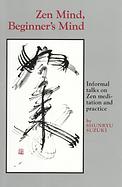
Zen Mind, Beginner's Mind is a book of teachings by the late Shunryu Suzuki, a compilation of talks given to his satellite Zen center in Los Altos, California. Published in 1970 by Weatherhill, the book is not academic. These are frank and direct transcriptions of Suzukis' talks recorded by his student Marian Derby. Trudy Dixon and Richard Baker—Baker was Suzuki's successor—edited the talks by choosing those most relevant, arranging them into chapters. According to some, it has become a spiritual classic, helping readers to steer clear from the trappings of intellectualism.
In the book we read, 'After zazen we bow to the floor nine times. By bowing, we are giving up ourselves. To give up ourselves means to give up our dualistic ideas. So there is no difference between zazen practice and bowing. Usually to bow means to pay our respects to something which is more worthy of respect than ourselves. But when you bow to Buddha you should have no idea of Buddha, you just become one with Buddha, you are already Buddha yourself.'
- These last two sentences are ones I should probably memorise, as I often find myself answering a question around this from new students or visiting high school kids - if there is no god in Buddhism, why are you bowing, who are you bowing to?" ~ more
Shunryu Suzuki (鈴木 俊隆 Suzuki Shunryū, dharma name Shōgaku Shunryū 祥岳俊隆) (May 18, 1904 – December 4, 1971) was a Sōtō Zen roshi (Zen Master) who popularized Zen Buddhism in the United States, particularly around San Francisco. Born in the Kanagawa Prefecture of Japan, Suzuki was occasionally mistaken for the Zen scholar D.T. Suzuki, to which Shunryu would reply, "No, he's the big Suzuki, I'm the little Suzuki."
The purpose of San Francisco Zen Center is to make accessible and embody the wisdom and compassion of the Buddha as expressed in the Soto Zen tradition established by Dogen Zenji in 13th-century Japan and conveyed to us by Suzuki Roshi and other Buddhist teachers. Our practice flows from the insight that all beings are Buddha, and that sitting in meditation is itself the realization of Buddha nature, or enlightenment.
• Shunryu Suzuki-roshi, a Japanese Zen priest belonging to the Soto lineage, came to San Francisco in 1959 at the age of fifty-four. Already a respected Zen master in Japan, he was impressed by the seriousness and quality of "beginner's mind" among Americans he met who were interested in Zen and decided to settle here. As more and more people of non-Japanese background joined him in meditation, Zen Center came into being and he was its first abbot. Under his tutelage, Zen Center grew into City Center, Green Gulch Farm and Tassajara Zen Mountain Center. He was undoubtedly one of the most influential Zen teachers of his time.
"In the beginner's mind there are many possibilities, but in the expert's there are few."
So begins this most beloved of all American Zen books. Seldom has such a small handful of words provided a teaching as rich as has this famous opening line of Shunryu Suzuki's classic. In a single stroke, the simple sentence cuts through the pervasive tendency students have of getting so close to Zen as to completely miss what it's all about. An instant teaching on the first page. And that's just the beginning. In the thirty years since its original publication, Zen Mind, Beginner's Mind has become one of the great modern Zen classics, much beloved, much re-read, and much recommended as the best first book to read on Zen. Suzuki Roshi presents the basics—from the details of posture and breathing in zazen to the perception of nonduality—in a way that is not only remarkably clear, but that also resonates with the joy of insight from the first to the last page. It's a book to come back to time and time again as an inspiration to practice.
...what you receive with trust is your one verse or your one phrase. Do not try to understand eighty thousand verses or phrases... ~ Dōgen Zenji
Study Hall - Shobogenzo -
Friday, March 11, 2011
"Know that as there are many aspects within the treasury of the true dharma eye, you cannot fully clarify it. Yet the treasury of the true dharma eye is expounded. There is no way you cannot have trust in it. Buddha sutras are like this. There are a number of them, but what you receive with trust is your one verse or your one phrase. Do not try to understand eighty thousand verses or phrases..."
"Ino" means "director of the meditation hall; supervises, attends, and assigns staffing for all sesshines and ceremonies." The ino leads the chanting service and recites the dedication of service...
(lit. "Treasury of the True Dharma Eye") The term Shōbōgenzō has three main usages in Buddhism: (1) It can refer to the essence of the Buddha's realization and teaching, that is, to the Buddha Dharma itself, as viewed from the perspective of Mahayana Buddhism, (2) it is the title of a koan collection with commentaries by Dahui Zonggao, and (3) it is used in the title of two works by Dogen Kigen... (more @Wikipedia)
Photograph of the title page of the Edition Honzanban (1811) of Dōgen's Shōbōgenzō
Dogen's Two Shōbōgenzōs
In Japan and the West, the term Shōbōgenzō is most commonly known as referring to the titles of two works composed by Japanese Zen master Dōgen Kigen in the mid-13th century.
The first, written and completed in 1235, the Shinji Shōbōgenzō, also known as the Mana Shōbōgenzō or Shōbōgenzō Sanbyakusoku, is a collection of 301 koans (public cases) and is written in Chinese, the language of the original texts from which the koans were taken. In this Dōgen was content simply to record the stories without interjecting his own remarks. A few years later, however, he embarked on a major project to develop extended commentaries on many of these and other passages from the Ch'an literature. The fruit of this project was his masterpiece--the remarkable collection of essays known as the kana, or "vernacular", Shōbō genzō.
道元禅師 • Dōgen Zenji (also Dōgen Kigen 道元希玄, or Eihei Dōgen 永平道元, or Koso Joyo Daishi) (19 January 1200 – 22 September 1253) was a Japanese Zen Buddhist teacher born in Kyōto, and the founder of the Sōtō school of Zen in Japan after travelling to China and training under the Chinese Caodong lineage there. Dōgen is known for his extensive writing including the Treasury of the Eye of the True Dharma or Shōbōgenzō, a collection of ninety-five fascicles concerning Buddhist practice and enlightenment.
The later Kana Shōbōgenzō consists of an overlapping assortment of essays and commentaries written in Japanese; different versions of the Kana Shōbōgenzō contain different sets of texts. (See: Heine, Dogen and the Koan Tradition)
When referring to Dogen's works, the term Shōbōgenzō by itself more commonly refers to the Kana Shōbōgenzō.
Study Hall - Shobogenzo
Friday, March 25, 2011
'Face-to-Face Transmission', 'Menju', is a lot of fun; Dogen gets personal, both for himself, and with an ad hominem section in the postscript:
If you do not realize the fruit at this moment, when will you realize it?
If you do not cut off delusion at this moment, when will you cut off delusion?
If you do not become a buddha at this moment, when will you?
If you do not sit as a buddha at this moment, when will you practice as an active buddha?
"...Enlightenment is like the moon reflected on the water. The moon does not get wet, nor is the water broken. Although its light is wide and great, the moon is reflected even in a puddle an inch wide. The whole moon and the entire sky are reflected in dewdrops on the grass, or even in one drop of water..."
my newest grandchild, Phoenix Don Agenbroad, arrived on Oct. 22
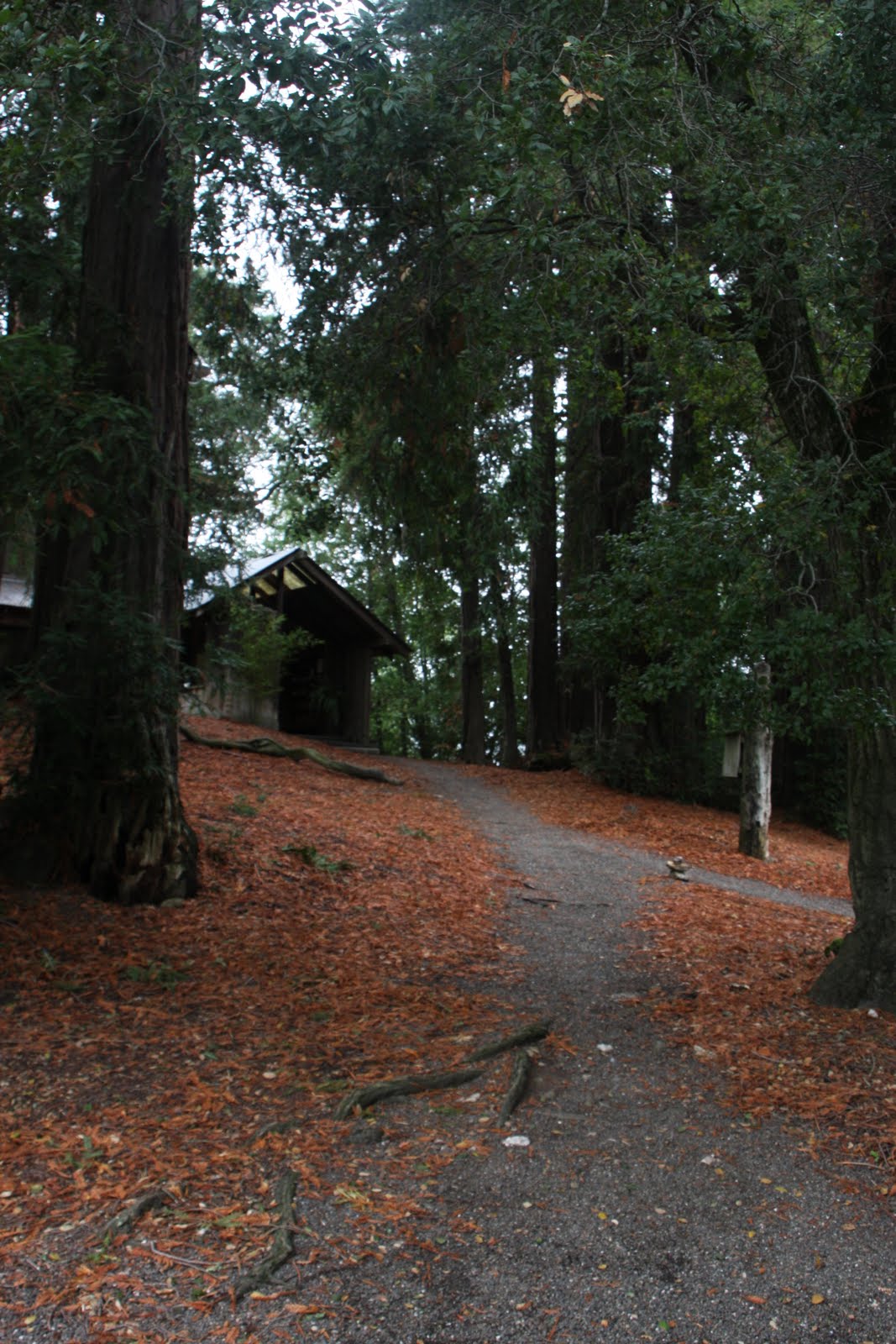
path to zendo
I recently participated in "SELF SETTLING into the SELF" One Day Sitting at Sonoma Mountain Zen Center.
An opportunity for beginners as well as experienced sitters to plunge into the heart of Zen practice, the retreat included Friday night dinner, evening meditation and overnight stay; 8 periods of meditation, bowing, formal meals, chanting, work practice, and dokusan (a private interview with Kwong-Roshi).
禅/禪
The Japanese word Zen is derived from the Chinese word Chán, which in turn is derived from the Sanskrit word dhyāna, which means "meditation" or "meditative state."
I have added a bit about Zen and Buddhism to my page "Master of the Sakuhachi," and also below in the ango section of this post.
I have also been attending the Fall Study Group at SMZC. The group was led by Shinko Kwong, and focused on Jakusho Kwong-roshi's book "No Beginning, No End"
हिन्दुस्तानी शास्त्रीय संगीत
Pandit Laxmi Ganesh Tewari, a renowned Hindustani vocalist from India, and dear teacher of mine from "back in the day," performed at SSU. It was great to see him after a long time. (The video is just one that i found on youtube) ... I added some info on North Indian Classical Music to the page that i created abut this.
Pani Bina (Kabir Bhajan) - (bhajans are devotional songs; Pandit Tewari sings this in light classical style)
Click for a video of him performing in the Classical Style several years ago - a really nice intro to the depth of his practice >> Rāga Bilaskhani Todi
• Suizen: A Zen practice consisting of playing the shakuhachi bamboo flute as a means of attaining self-realization. The monks from the Fuke sect of Zen who practiced suizen using the shakuhachi as a spiritual tool are called Komusō (literally "emptiness monks").
I attended a talk by Rev. Juko Nakano, Sotoshu Specially Dispatched Teacher, Head Priest of Chorakuji Temple, Fukushima Prefecture, Japan, at Sonoma Mountain Zen Center. The page I created about this, Dharma talk - What is “kind speech?", contains an excellent message from Head Priest of the Sotoshu, Omichi Kosen Zenji. I also include a bit about zen on the page.
Kwong-Roshi has long envisioned creating a Mandala of buildings on Sonoma Mountain to continue Suzuki-roshi’s lineage and support authentic practice, dedicated to the protection and awakening of all beings, for the next three hundred years.
I was privileged to attend mid-morning zazen for the last three days of Sonoma Mountain Zen Center Summer Ango, and to participate in the closing ceremony. Demian Nyoze Kwong (center) served as shuso (head monk) during the time I attended.
安居
• Ango is a Japanese term for a period of intense training for students of Zen Buddhism, lasting anywhere from {30} to 100 days. The practice during ango consists of meditation (zazen), study, and work (samu).
坐禅
• Zazen is at the heart of Zen Buddhist practice. The aim of zazen is just sitting, "opening the hand of thought." Once the mind is able to be unhindered by its many layers, one will then be able to realize one's true Buddha nature. In Zen Buddhism, zazen (literally "seated meditation") is a meditative discipline practitioners perform to calm the body and the mind and experience insight into the nature of existence and thereby gain enlightenment.
悟
Satori is a Japanese Buddhist term for enlightenment that literally means "understanding". In the Zen Buddhist tradition, satori refers to a flash of sudden awareness, or individual enlightenment, and is considered a "first step" or embarkation toward nirvana. Satori is typically juxtaposed with the related term kensho, which translates as "seeing one's nature". Kensho experiences tend to be briefer glimpses, while satori is considered to be a deeper spiritual experience.
निर्वाण
• Nirvāna is a central concept in Indian religions - the state of being free from suffering. The word literally means "blowing out" — referring, in the Buddhist context, to the blowing out of the fires of greed, hatred, and delusion.
見性
• Kenshō is a Japanese term for enlightenment experiences. It is most commonly used within the confines of Zen Buddhism.
Literally it means "seeing one's nature" or "true self." It generally "refers to the realization of nonduality of subject and object." Frequently used in juxtaposition with satori (or, "catching on"), there is sometimes a distinction made between the two in that some consider satori to be qualitatively deeper. Kenshō itself has been said to be "...a blissful realization where a person's inner nature, the originally pure mind, is directly known as an illuminating emptiness, a thusness which is dynamic and immanent in the world." Kenshō experiences are tiered, in that they escalate from initial glimpses into the nature of mind, on to an experience of emptiness, and then perhaps on to Buddhahood.
只管打坐
Shikantaza is a Japanese term for zazen introduced by Rujing and associated most with the Soto school of Zen Buddhism, but which also is "the base of all Zen disciplines." According to Dōgen Zenji, shikantaza i.e. resting in a state of brightly alert attention that is free of thoughts, directed to no object, and attached to no particular content—is the highest or purest form of Zazen, zazen as it was practiced by all the buddhas of the past.
The posture of zazen is seated, with folded legs and hands, and an erect but settled spine. The legs are folded in one of the standard sitting styles. The hands are folded together into a simple mudra over the belly. In many practices, one breathes from the hara (the center of gravity in the belly) and the eyelids are half-lowered, the eyes being neither fully open nor shut so that the practitioner is not distracted by outside objects but at the same time is kept awake. Long periods of zazen, usually performed in groups at a zendo (meditation hall), may alternate with periods of kinhin (walking meditation). The beginning of a zazen period is traditionally announced by ringing a bell three times, and the end of a round by ringing the bell once. Before and after sitting, Zen practitioners perform a gassho bow to their seat, to fellow practitioners and to the teacher/guru.
• Samu: Work service, meditation in work; refers to work that is done to promote mindfulness, such as chopping wood or sweeping floors. Samu is popular in Zen monasteries. Mindfulness means accepting reality just as it is. Samu is a means of finding Buddha-nature in everyday life, that reality has ever been pure from the very beginning, which was the central idea behind a popular movement in Japan, where Zen is commonly practiced today, called, 'Primordial Enlightenment'*
Samu, the cultivation of work as spiritual practice, is one of the four principal components of Zen practice along with zazen, teisho, and dokusan. It is essential that we learn to enter into work as an act of self-purification and realization. Samu includes the practice of dana (giving or generosity), mindfulness, and devotion - training sessions are crucial as they provide a way of taking one's practice off the mat into one's daily life. Samu practice is not a substitute for sitting meditation but is rather the extension of meditation to its function. Samu and sitting meditation are therefore highly interrelated and interdependent - (from Zen Center of Denver website page on training).
*(the enlightened state, i.e. the Sugatagarbha all sentient beings already possess - the way things really are, the way things really exist from the very beginning - called primordial enlightenment, because this state is always there and never was not, (and) as we, sentient beings, have apparently wandered from the knowledge, which is already there as our true mode of existence; (and) therefore, we have to be re-enlightened, i.e. come to recognize the primordial enlightened state already present in us, and through practice become established in it - from Byoma Kusuma Buddhadharma Sangh, Enlightenment: Buddhism Vis-à-Vis Hinduism")
Contrary Ways
-
"She insulted me, she hurt me, she defeated me, she robbed me."
Those who think such thoughts, will not be free from hate.
"She insulted me, she hurt me,...
The Deep End
-
Steve Weintraub had us all laughing during his dharma talk on Saturday when
he likened Zen practice to being thrown into the deep end of the swimming
pool ...
Changing The Meaning
-
It is inevitable that you are going to encounter some uncomfortable
situations in your life, everybody does. Our untrained egos are very
sensitive and ca...
The Mudra
-
Anyone who stops by this blog knows that I'm fascinated with the mudra of
zazen. I'm enthralled not only with what Dogen calls "The Buddha Mudra",
but also...

道元禅師






 Posts
Posts