see also:
whats more: Fukushima second explosion | Occupy Nuclear
whats up: Remembering Fukushima And What You Can Do | Risky Reactors & Deadly Waste
original series: whats more: fukushima art
NO NUKES | RE-TOOL NOW
whats up RC'S NUCLEAR BLOG

updated presentation of a photo from last year
> what it is: red leaves, autumn wind update
original: what it is: red leaves, autumn wind
red leaves align
with force of wind
all the buddhas shout
俳句
Haiku (haikai verse), plural haiku, is a form of Japanese poetry, consisting of 17 moras (or on), in three phrases of 5, 7, and 5 moras respectively. Although haiku are often stated to have 17 syllables, this is inaccurate as syllables and moras are not the same. Haiku typically contain a kigo (seasonal reference), and a kireji (cutting word). In Japanese, haiku are traditionally printed in a single vertical line and tend to take aspects of the natural world as their subject matter, while haiku in English often appear in three lines to parallel the three phrases of Japanese haiku and may deal with any subject matter.
 |
| "Tara - she is everywhere" |

"Tara reconstruction" was created from photo what it is: ripped up (January 18, 2009)
dark!
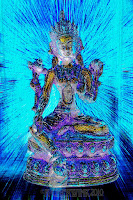
Within Tibetan Buddhism Tara is regarded as a Boddhisattva of compassion and action. She is the female aspect of Avalokitesvara (Chenrezig) and in some origin stories she comes from his tears...
buddha 100407
tara 8790 (more)
Bhumisparsha Mudrā update
Bhumisparsha Mudrā
Vajrapani 100514
Diamond Sutra
Dharma Wheel & About Dharma
buddha cave
• whats more: more about Buddhism
• Wikipedia
Tara

the attached file is suitable for high resolution photo printing at 4 x 6 - please feel free to print some and pass them around :)NOW AVAILABLE FOR PURCHASE AS A PRINT AT deviantArt


self portrait, roseadjoa


"Now those who recite this Sutra and then try to put it in practice will accumulate merit as countless as the sands of Arizona and Nevada; will help save the planet Earth from total oil slick; will enter the age of harmony of man and nature; will win the tender love and caresses of men, women, and beasts; will always have ripened blackberries to eat and a sunny spot under a pine tree to sit at; and, in the end will win highest perfect enlightenment."
~ Gary Snyder, Smokey The Bear Sutra

re Snyder: "His work, in his various roles, reflects an immersion in both Buddhist spirituality and nature."


DROWN THEIR BUTTS
CRUSH THEIR BUTTS
DROWN THEIR BUTTS
CRUSH THEIR BUTTS


[Sonoma Mountain Zen Center, Feb. 26 2011]
Now, yesterday, a hundred thousand or more years ago - that's how it looks. Teacher and students. SMZC, winter sesshin)

Direct pointing at the mind of man, seeing one's nature and becoming Buddha.
Hakuin Ekaku (白隠 慧鶴?, January 19, 1685 - January 18, 1768) was one of the most influential figures in Japanese Zen Buddhism. He revived the Rinzai school from a moribund period of stagnation, refocusing it on its traditionally rigorous training methods integrating meditation and koan practice. Hakuin's influence was such that all Rinzai Zen masters today trace their lineage through him, and all modern practitioners of Rinzai Zen use practices directly derived from his teachings.
Scroll calligraphy by Hakuin Ekaku (depicts Bodhidharma). Caption: Jikishin ninshin, Kensho jobutsu: “Direct pointing at the mind of man, seeing one's nature and becoming Buddha.”
Kōan is used both as a meditation device and as an expression of Enlightenment (satori)– a radical experiential insight into the nature of things and the self alike.
悟
• Satori is a Japanese Buddhist term for enlightenment that literally means "understanding". In the Zen Buddhist tradition, satori refers to a flash of sudden awareness, or individual enlightenment, and is considered a "first step" or embarkation toward nirvana. Satori is typically juxtaposed with the related term kensho, which translates as "seeing one's nature". Kensho experiences tend to be briefer glimpses, while satori is considered to be a deeper spiritual experience.
निर्वाण
• Nirvāna is a central concept in Indian religions - the state of being free from suffering. The word literally means "blowing out" — referring, in the Buddhist context, to the blowing out of the fires of greed, hatred, and delusion.
見性
• Kenshō is a Japanese term for enlightenment experiences. It is most commonly used within the confines of Zen Buddhism.
Literally it means "seeing one's nature" or "true self." It generally "refers to the realization of nonduality of subject and object." Frequently used in juxtaposition with satori (or, "catching on"), there is sometimes a distinction made between the two in that some consider satori to be qualitatively deeper. Kenshō itself has been said to be "...a blissful realization where a person's inner nature, the originally pure mind, is directly known as an illuminating emptiness, a thusness which is dynamic and immanent in the world." Kenshō experiences are tiered, in that they escalate from initial glimpses into the nature of mind, on to an experience of emptiness, and then perhaps on to Buddhahood.
着語
Jakugo
A Capping Phrase (着語/箸語 jakugo?), or 下語 (agyo?) of a kōan is a proof of solution of the case riddle, but not the solution itself. In Zen Buddhism, kōan is used both as a meditation device and as an expression of Enlightenment (悟り/覚り satori?) – a radical experiential insight into the nature of things and the self alike. A capping phrase is supposedly an articulation of such enlightening experience, most of the time in verse.
V. Sōgen Hori describes the process of the kōan training as follows:
"Rinzai monasteries in Japan vary in the way they conduct kōan practice, but in the Myōshin-ji–Daitoku-ji branch, when a monk has passed a kōan the Zen teacher will instruct him to bring a “capping phrase” ... The monk selects a verse or phrase that expresses the insight he has had while meditating on the kōan. He searches for this capping phrase in one of the several Zen phrase books that have been especially compiled for this purpose. If the monk continues into advanced stages of the Rinzai Zen kōan curriculum, he will receive further literary assignments: the writing of explanations in Japanese, called kakiwake 書き分け, and the composition of Chinese-style poetry, called nenrō 拈弄... The research and writing required to complete kakiwake and nenrō writing assignments can consume considerable amounts of time during the later stages of a monk’s stay in the monastery."

"...concentrate yourself into this 'Wú'... making your whole body one great inquiry. Day and night work intently at it. Do not attempt nihilistic or dualistic interpretations."
無
Wú (Chinese traditional: 無, simplified: 无 pinyin: wú ) - Mu in Japanese/Korean, is a negation which has been translated variously as "not," "nothing," "without," "nothingness," "non existent," "non being," or evocatively simply as "no thing." [neutrality is disputed]
Arousing this great inquiry or "Great Doubt" is an essential element of kōan practice. To illustrate the enormous concentration required in kōan meditation, Zen Master Wumen commented
It is like swallowing a red-hot iron ball. You try to vomit it out, but you can't.
Kōan | Jakugo
Zen Buddhism
Hakuin Ekaku | Bodhidharma
Satori | Nirvāna | Kenshō
External links -
The Gateless Gate - 48 Zen kōans compiled in the early 13th century
Book of Serenity A collection of 100 kōans, originally compiled in the 12th century
• "...about Zen & Buddhism"
• "autumn wind (not exactly haiku?)"
• Zen Playlist at YouTube

"hazardous - do not use!"

New report finds secret toxic chemicals in brand name cleaners

Derivative work made with two files from Wikipedia Commons -
Vajrapāṇi (from Sanskrit vajra, "thunderbolt" or "diamond" and pāṇi, lit. "in the hand") is one of the earliest bodhisattvas of Mahayana Buddhism. He is the protector and guide of the Buddha, and rose to symbolize the Buddha's power. Vajrapani was used extensively in Buddhist iconography as one of the three protective deities surrounding the Buddha. Each of them symbolizes one of the Buddha's virtues: Manjusri (the manifestation of all the Buddhas' wisdom), Avalokitesvara (the manifestation of all the Buddhas' compassion) and Vajrapani (the manifestation of all the Buddhas' power).
On the popular level, Vajrapani, Holder of the Thunderbolt Scepter (symbolizing the power of compassion), is the Bodhisattva who represents the power of all the Buddhas, just as Avalokitesvara represents their great compassion, Manjushri their wisdom, and Tara their miraculous deeds. For the yogi, Vajrapani is a means of accomplishing fierce determination and symbolizes unrelenting effectiveness in the conquest of negativity. His taut posture is the active warrior pose (pratayalidha), based on an archer's stance but resembling the en garde position in Western fencing. His outstretched right hand brandishes a vajra and his left hand deftly holds a lasso - with which he binds demons. He wears a skull crown with his hair standing on end. His expression is wrathful and he has a third eye. Around his neck is a serpent necklace and his loin cloth is made up of the skin of a tiger, whose head can be seen on his right knee.
According to the Pancavimsatisahasrika and Astasahasrika Prajnaparamita any Bodhisattva on the path to Buddhahood is eligible for Vajrapani's protection, making them invincible to any attacks "by either men or ghosts".
Vajrapāṇi is the patron saint of the Shaolin monastery.
In Japan, Vajrapani is known as Shukongōshin (執金剛神, "Diamond rod-wielding God"), and has been the inspiration for the Niō (仁王, lit. Benevolent kings), the wrath-filled and muscular guardian god of the Buddha, standing today at the entrance of many Buddhist temples under the appearance of frightening wrestler-like statues.
• More on Vajrapāṇi at Wikipedia
• Original post (art development): Vajrapani-100514
• About Mahayana Buddhism at Wikipedia


All conditioned phenomena
Are like dreams, illusions, bubbles, or shadows;
Like drops of dew, or flashes of lightning;
Thusly should they be contemplated.
Click here for an English translation of the Diamond Sutra

 Buddha footprint
त्रिरत्न
The Three Jewels, also called the Three Treasures, the Three Refuges, or the Triple Gem (triratna)), are the three things that Buddhists take refuge in, and look toward for guidance, in the process known as taking refuge.
The Three Jewels are:
• Buddha
Sanskrit, Pali: The Enlightened or Awakened One - Depending on one's interpretation, can mean the historical Buddha (Shakyamuni) or the Buddha nature—the ideal or highest spiritual potential that exists within all beings;
• Dharma
Sanskrit: The Teaching; Pali: Dhamma - The teachings of the Buddha.
• Sangha
Sanskrit, Pali: The Community - The community of those who have attained enlightenment, who may help a practicing Buddhist to do the same. Also used more broadly to refer to the community of practicing Buddhists.
• More about Buddhism on whats more blog
@ Master of the Shakuhachi#zen


Derivative work made with two files from Wikipedia Commons -

Vajrapāṇi (from Sanskrit vajra, "thunderbolt" or "diamond" and pāṇi, lit. "in the hand") is one of the earliest bodhisattvas of Mahayana Buddhism. He is the protector and guide of the Buddha, and rose to symbolize the Buddha's power. Vajrapani was used extensively in Buddhist iconography as one of the three protective deities surrounding the Buddha. Each of them symbolizes one of the Buddha's virtues: Manjusri (the manifestation of all the Buddhas' wisdom), Avalokitesvara (the manifestation of all the Buddhas' compassion) and Vajrapani (the manifestation of all the Buddhas' power).
On the popular level, Vajrapani, Holder of the Thunderbolt Scepter (symbolizing the power of compassion), is the Bodhisattva who represents the power of all the Buddhas, just as Avalokitesvara represents their great compassion, Manjushri their wisdom, and Tara their miraculous deeds. For the yogi, Vajrapani is a means of accomplishing fierce determination and symbolizes unrelenting effectiveness in the conquest of negativity. His taut posture is the active warrior pose (pratayalidha), based on an archer's stance but resembling the en garde position in Western fencing. His outstretched right hand brandishes a vajra and his left hand deftly holds a lasso - with which he binds demons. He wears a skull crown with his hair standing on end. His expression is wrathful and he has a third eye. Around his neck is a serpent necklace and his loin cloth is made up of the skin of a tiger, whose head can be seen on his right knee.
According to the Pancavimsatisahasrika and Astasahasrika Prajnaparamita any Bodhisattva on the path to Buddhahood is eligible for Vajrapani's protection, making them invincible to any attacks "by either men or ghosts".[4]
Vajrapāṇi is the patron saint of the Shaolin monastery.
In Japan, Vajrapani is known as Shukongōshin (執金剛神, "Diamond rod-wielding God"), and has been the inspiration for the Niō (仁王, lit. Benevolent kings), the wrath-filled and muscular guardian god of the Buddha, standing today at the entrance of many Buddhist temples under the appearance of frightening wrestler-like statues.


 Posts
All Comments
Posts
All Comments