red leaves align with force of wind all the buddhas shout
reflections, and a bit about Haiku - with edited notes from Wikipedia
red leaves
align
force
of wind
all the
buddhas
shout
not exactly haiku?
It depends on how you count it up. Most people think that a Haiku consists of 17 syllables; but, this isn't right. What is counted is actually "mora," which are not the same as syllables.
In contrast to English verse typically characterized by meter, Japanese verse counts sound units (moras), known as "on". Traditional haiku consist of 17 on, in three phrases of five, seven, and five on, respectively.
does it add up?
...maybe if I had included "autumn" in the phrase "with force of {autumn} wind," then it would add up? - and perhaps it would even meet the 5,7,5 moras/phrase scheme somehow? I don't know how some words would be counted. For example, would "leaves" be counted as 2 mora?
俳句 Haiku (haikai verse), plural haiku, is a form of Japanese poetry, consisting of 17 moras (or on), in three phrases of 5, 7, and 5 moras respectively. Although haiku are often stated to have 17 syllables, this is inaccurate as syllables and moras are not the same. Haiku typically contain a kigo (seasonal reference), and a kireji (cutting word). In Japanese, haiku are traditionally printed in a single vertical line and tend to take aspects of the natural world as their subject matter, while haiku in English often appear in three lines to parallel the three phrases of Japanese haiku and may deal with any subject matter.
音字 Onji is an obsolete Japanese word used in English-language discussion of Japanese poetry to mean the phonetic units counted in haiku, tanka and other such poetic forms. Known as "morae" to English-speaking linguists, the modern Japanese term for the linguistic concept is hyōon moji (表音文字) while the normal Japanese term in the context of counting sounds in poetry is "on". On (音) is Japanese for "sound" and ji (字) is Japanese for "symbol" or "character".
An English syllable may contain one, two or three morae.
Although the word "on" is often translated as "syllable", in fact one on is counted for a short syllable, an additional one for an elongated vowel, diphthong, or doubled consonant, and one more for an "n" at the end of a syllable. Thus, the word "haibun", though counted as two syllables in English, is counted as four on in Japanese (ha-i-bu-n). In addition, some sounds, such as "kyo" (きょ) can be perceived as two syllables in English but as a single on in Japanese. A word that illustrates both these issues is "Tokyo" (とうきょう), which is perceived as having three syllables in English (To-ky-o) but four moras in Japanese (To-o-kyo-o).
kigo & keriji
...and I guess the words "align" or "shout" should qualify as kireji (cutting words); and I leave "red" in association with "leaves" to count as the reference to a season (kigo), so maybe its not so bad either way.
季語 Kigo ( "season word") is a word or phrase associated with a particular season, used in Japanese poetry. Kigo are used in the collaborative linked-verse forms renga and renku, as well as in haiku, to indicate the season referred to in the stanza. They are valuable in providing economy of expression. 切れ字
In Japanese haiku a kireji, or cutting word, typically appears at the end of one of the verse's three phrases. A kireji fills a role somewhat analogous to a caesura in classical western poetry or to a volta in sonnets.
Depending on which cutting word is chosen, and its position within the verse, it may briefly cut the stream of thought, suggesting a parallel between the preceding and following phrases, or it may provide a dignified ending, concluding the verse with a heightened sense of closure.
red leaves align
with force of wind,
{and} all the buddhas shout
red leaves align,
{while} with force of wind
all the buddhas shout
"red leaves align
with force of wind,"
all the buddhas shout
haiku in english
But then, of course, this isn't in Japanese either; and while I wasn't really trying to write haiku according to rules in the first place, one might want to explore Haiku in English as a topic. In any case, it is the way it turned out and so it is what it is!
English haiku do not adhere to the strict syllable count found in Japanese haiku, and the typical length of haiku appearing in the main English-language journals is 10–14 syllables. Some haiku poets are concerned with their haiku being expressed in one breath and the extent to which their haiku focus on "showing" as opposed to "telling". This is the genius of haiku using an economy of words to paint a multi-tiered painting, without "telling all".
Or as Matsuo Bashō puts it, "The haiku that reveals seventy to eighty percent of its subject is good. Those that reveal fifty to sixty percent, we never tire of."
Translating back and forth between English and Japanese
Here it is in Japanese from Google Translate (three lines with no punctuation) -
• red leaves align
with force of wind
all the buddhas shout
赤は合わせ葉
風の力で
すべての佛が叫ぶ Aka wa awase ha-fū no chikara de subete no hotoke ga sakebu
- and google translate sends that back to English as
Red Leaf suit
Wind power
All Buddha cry
Hmm. Any help with this appreciated :) Gomen nasai - my Sanskrit it seems, even as limited as it is, proves to be much better than my Japanese!
夢 Dreams (Yume; aka Akira Kurosawa's Dreams, I Saw a Dream Like This, or Such Dreams I Have Dreamed) is a 1990 magical realism film based on actual dreams of the film's director, Akira Kurosawa at different stages of his life. The film is based more on imagery than on dialogue, and the dreams are presented as eight separate segments.
The alternative titles ("I Saw a Dream Like This") are a translation of the opening line of Ten Nights of Dreams, by Natsume Sōseki, which begins: Konna yume wo mita ~ こんな 夢 を見た
Sunshine Through The Rain Pt.2
There is an old legend in Japan that states that when the sun is shining through the rain, the Kitsune (foxes) have their weddings. In this first dream, a boy defies the wish of a woman, possibly his mother, to remain at home during a day with such weather. From behind a large tree in the nearby forest, he witnesses the slow wedding procession of the kitsune...
狐 kitsune (kitsɯne) is the Japanese word for fox. Foxes are a common subject of Japanese folklore; in English, kitsune refers to them in this context. Stories depict them as intelligent beings and as possessing magical abilities that increase with their age and wisdom. Foremost among these is the ability to assume human form. While some folktales speak of kitsune employing this ability to trick others—as foxes in folklore often do—other stories portray them as faithful guardians, friends, lovers, and wives.
The Peach Orchard Pt.2
Hina Matsuri, the Doll Festival, traditionally takes place in spring when the peach blossoms are in full bloom. The dolls that go on display at this time, they say, are representative of the peach trees and their pink blossoms. One boy's family, however, has chopped down their peach orchard, so the boy feels a sense of loss during this year's festival. After being scolded by his older sister the boy spots a small girl running out the front door. He follows her to the now-treeless orchard, where the dolls from his sister's collection have come to life and are standing before him on the slopes of the orchard. The living dolls, revealing themselves to be the spirits of the peach trees, berate the boy about chopping down the precious trees. But after realizing how much he loved the blossoms, they agree to give him one last glance at the peach trees by way of a slow and beautiful dance to Etenraku. After they disappear the boy finds the small girl walking among the treeless orchard before seeing a single peach tree sprouting in her place.
越天楽 Etenraku, literally music brought from heaven) is a gagaku melody and dance. It is usually played with a hichiriki or ryūteki, and is accompanied by other traditional instruments such as the shō, koto and kakko.
雅楽 Gagaku (literally "elegant music") is a type of Japanese classical music that has been performed at the Imperial Court in Kyoto for several centuries.
my newest grandchild, Phoenix Don Agenbroad, arrived on Oct. 22
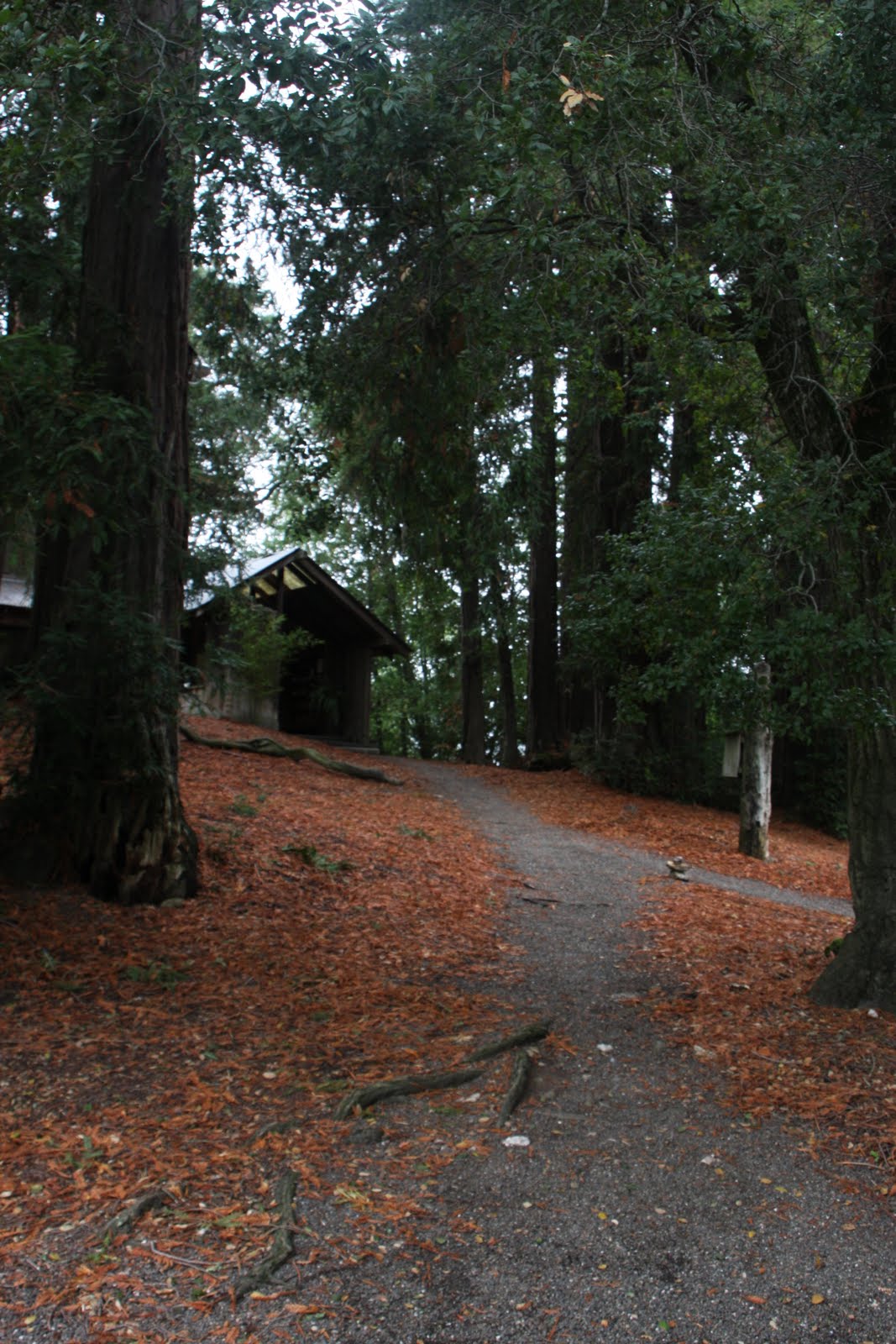
path to zendo
I recently participated in "SELF SETTLING into the SELF" One Day Sitting at Sonoma Mountain Zen Center.
An opportunity for beginners as well as experienced sitters to plunge into the heart of Zen practice, the retreat included Friday night dinner, evening meditation and overnight stay; 8 periods of meditation, bowing, formal meals, chanting, work practice, and dokusan (a private interview with Kwong-Roshi).
禅/禪
The Japanese word Zen is derived from the Chinese word Chán, which in turn is derived from the Sanskrit word dhyāna, which means "meditation" or "meditative state."
I have added a bit about Zen and Buddhism to my page "Master of the Sakuhachi," and also below in the ango section of this post.
I have also been attending the Fall Study Group at SMZC. The group was led by Shinko Kwong, and focused on Jakusho Kwong-roshi's book "No Beginning, No End"
हिन्दुस्तानी शास्त्रीय संगीत
Pandit Laxmi Ganesh Tewari, a renowned Hindustani vocalist from India, and dear teacher of mine from "back in the day," performed at SSU. It was great to see him after a long time. (The video is just one that i found on youtube) ... I added some info on North Indian Classical Music to the page that i created abut this.
Pani Bina (Kabir Bhajan) - (bhajans are devotional songs; Pandit Tewari sings this in light classical style)
Click for a video of him performing in the Classical Style several years ago - a really nice intro to the depth of his practice >> Rāga Bilaskhani Todi
• Suizen: A Zen practice consisting of playing the shakuhachi bamboo flute as a means of attaining self-realization. The monks from the Fuke sect of Zen who practiced suizen using the shakuhachi as a spiritual tool are called Komusō (literally "emptiness monks").
I attended a talk by Rev. Juko Nakano, Sotoshu Specially Dispatched Teacher, Head Priest of Chorakuji Temple, Fukushima Prefecture, Japan, at Sonoma Mountain Zen Center. The page I created about this, Dharma talk - What is “kind speech?", contains an excellent message from Head Priest of the Sotoshu, Omichi Kosen Zenji. I also include a bit about zen on the page.
Kwong-Roshi has long envisioned creating a Mandala of buildings on Sonoma Mountain to continue Suzuki-roshi’s lineage and support authentic practice, dedicated to the protection and awakening of all beings, for the next three hundred years.
I was privileged to attend mid-morning zazen for the last three days of Sonoma Mountain Zen Center Summer Ango, and to participate in the closing ceremony. Demian Nyoze Kwong (center) served as shuso (head monk) during the time I attended.
安居
• Ango is a Japanese term for a period of intense training for students of Zen Buddhism, lasting anywhere from {30} to 100 days. The practice during ango consists of meditation (zazen), study, and work (samu).
坐禅
• Zazen is at the heart of Zen Buddhist practice. The aim of zazen is just sitting, "opening the hand of thought." Once the mind is able to be unhindered by its many layers, one will then be able to realize one's true Buddha nature. In Zen Buddhism, zazen (literally "seated meditation") is a meditative discipline practitioners perform to calm the body and the mind and experience insight into the nature of existence and thereby gain enlightenment.
悟
Satori is a Japanese Buddhist term for enlightenment that literally means "understanding". In the Zen Buddhist tradition, satori refers to a flash of sudden awareness, or individual enlightenment, and is considered a "first step" or embarkation toward nirvana. Satori is typically juxtaposed with the related term kensho, which translates as "seeing one's nature". Kensho experiences tend to be briefer glimpses, while satori is considered to be a deeper spiritual experience.
निर्वाण
• Nirvāna is a central concept in Indian religions - the state of being free from suffering. The word literally means "blowing out" — referring, in the Buddhist context, to the blowing out of the fires of greed, hatred, and delusion.
見性
• Kenshō is a Japanese term for enlightenment experiences. It is most commonly used within the confines of Zen Buddhism.
Literally it means "seeing one's nature" or "true self." It generally "refers to the realization of nonduality of subject and object." Frequently used in juxtaposition with satori (or, "catching on"), there is sometimes a distinction made between the two in that some consider satori to be qualitatively deeper. Kenshō itself has been said to be "...a blissful realization where a person's inner nature, the originally pure mind, is directly known as an illuminating emptiness, a thusness which is dynamic and immanent in the world." Kenshō experiences are tiered, in that they escalate from initial glimpses into the nature of mind, on to an experience of emptiness, and then perhaps on to Buddhahood.
只管打坐
Shikantaza is a Japanese term for zazen introduced by Rujing and associated most with the Soto school of Zen Buddhism, but which also is "the base of all Zen disciplines." According to Dōgen Zenji, shikantaza i.e. resting in a state of brightly alert attention that is free of thoughts, directed to no object, and attached to no particular content—is the highest or purest form of Zazen, zazen as it was practiced by all the buddhas of the past.
The posture of zazen is seated, with folded legs and hands, and an erect but settled spine. The legs are folded in one of the standard sitting styles. The hands are folded together into a simple mudra over the belly. In many practices, one breathes from the hara (the center of gravity in the belly) and the eyelids are half-lowered, the eyes being neither fully open nor shut so that the practitioner is not distracted by outside objects but at the same time is kept awake. Long periods of zazen, usually performed in groups at a zendo (meditation hall), may alternate with periods of kinhin (walking meditation). The beginning of a zazen period is traditionally announced by ringing a bell three times, and the end of a round by ringing the bell once. Before and after sitting, Zen practitioners perform a gassho bow to their seat, to fellow practitioners and to the teacher/guru.
• Samu: Work service, meditation in work; refers to work that is done to promote mindfulness, such as chopping wood or sweeping floors. Samu is popular in Zen monasteries. Mindfulness means accepting reality just as it is. Samu is a means of finding Buddha-nature in everyday life, that reality has ever been pure from the very beginning, which was the central idea behind a popular movement in Japan, where Zen is commonly practiced today, called, 'Primordial Enlightenment'*
Samu, the cultivation of work as spiritual practice, is one of the four principal components of Zen practice along with zazen, teisho, and dokusan. It is essential that we learn to enter into work as an act of self-purification and realization. Samu includes the practice of dana (giving or generosity), mindfulness, and devotion - training sessions are crucial as they provide a way of taking one's practice off the mat into one's daily life. Samu practice is not a substitute for sitting meditation but is rather the extension of meditation to its function. Samu and sitting meditation are therefore highly interrelated and interdependent - (from Zen Center of Denver website page on training).
*(the enlightened state, i.e. the Sugatagarbha all sentient beings already possess - the way things really are, the way things really exist from the very beginning - called primordial enlightenment, because this state is always there and never was not, (and) as we, sentient beings, have apparently wandered from the knowledge, which is already there as our true mode of existence; (and) therefore, we have to be re-enlightened, i.e. come to recognize the primordial enlightened state already present in us, and through practice become established in it - from Byoma Kusuma Buddhadharma Sangh, Enlightenment: Buddhism Vis-à-Vis Hinduism")
I went to hear Tewariji sing tonight. It was great to see him after a long time!
नमस्ते Namaste!
I was privileged to study with him during the late seventies/early eighties.
Laxmi G. Tewari performing, February 2007, photograph by Linnea Mullins
Pandit Laxmi Ganesh Tewari is a renowned Hindustani vocalist from India. He is an exponent of the Gwalior gharana (tradition) of vocal music. After studying with Dr. Lalmani Misra at Banaras Hindu University in Varanasi, he pursued education and teaching opportunities in America. At Sonoma State University since 1974, his career has combined performance, scholarship and teaching. (click for more at Wikipedia)
Click for a video of him performing in the Classical Style several years ago - a really nice intro to the depth of his practice >> Rāga Bilaskhani Todi
Tewari has been on the faculty of Sonoma State University in California since 1974. Today he is one of the leading ethnomusicologists with an exemplary body of work on Indian, Buddhist, Arabian and Gamelan music. He has also made numerous recordings of his music; chief amongst them is his rendering of Sameshwari, a Raga created by Dr. Lalmani Misra to preserve the notes of Samagana of Sama Veda period. He has conducted field research in India, Turkey, Trinidad & Tobago, Thailand, Fiji, Ghana, and Zimbabwe. In addition to his books and recordings, Tewari's articles have appeared in South Asia Research, South Asia Journal, and Asian Folklore Studies.
हिन्दुस्तानी शास्त्रीय संगीत
Hindustani classical music (Hindi: हिन्दुस्तानी शास्त्रीय संगीत, (Urdu: شاستریہ سنگیت ہندوستانی) is the Hindustani or erstwhile North Indian style of Indian classical music. It is a tradition that originated in Vedic ritual chants and has been evolving from the 12th century AD, in what are now northern India, Bangladesh, and Pakistan, and also Nepal and Afghanistan, and is today one of the two parts of Indian classical music, with the other one being Carnatic music, which represents the music of South India.
Pani Bina (Kabir Bhajan) - (bhajans are devotional songs; Pandit Tewari sings this in light classical style)
• The Gwalior Gharana is one of the oldest Khayal Gharanas and one to which most classical Indian musicians can trace the origin of their style. The rise of the Gwalior Gharana started with the reign of the great Mughal emperor Akbar (1542–1605). The favorite singers of this patron of the arts, such as Miyan Tansen, first amongst the vocalists at the court, came from the town of Gwalior.
ख़्याल • Khayal (or Khayal, Hindi: ख़्याल, Urdu: خیال) is the modern genre of classical singing in North India. Its name comes from an Arabic word meaning "imagination." Like all Indian classical music, khyal is modal, with a single melodic line and no harmonic parts. The modes are called raga, and each raga is a complicated framework of melodic rules.
The origins of Indian classical music can be found in the Vedas, which are the oldest scriptures in the Hindu tradition. Indian classical music has also been significantly influenced by, or syncretized with, Indian folk music and Persian music. The Samaveda, one of the four Vedas, describes music at length. The Samaveda was derived from the Rigveda in order that its hymns could be sung as Samagana; this style evolved into jatis and eventually into ragas. Bharat's Natyashastra was the first treatise laying down fundamental principles of dance, music and drama.
Indian classical music is both elaborate and expressive. Like Western classical music, it divides the octave into 12 semitones of which the 7 basic notes are, in ascending tonal order, Sa Re Ga Ma Pa Dha Ni Sa, similar to Western music's Do Re Mi Fa Sol La Ti Do. However, Indian music uses the just intonation tuning, unlike most modern Western classical music, which uses the equal-temperament tuning system.
Indian classical music is monophonic in nature and based around a single melody line, which is played over a fixed drone. The performance is based melodically on particular ragas and rhythmically on talas. Because of the focus on exploring the raga, performances have traditionally been solo endeavors, but duets are gaining in popularity.
Indian Classical Music Core Concepts: Shruti · Swara · Rāga · Tāla
The shruti (Sanskrit "thing heard", "sound"; also written as śruti) is the smallest interval of the tuning system in Indian classical music.
The seven notes of the scale (swaras), in Indian music are named shadja, rishabh, gandhar, madhyam, pancham, dhaivat and nishad, usually shortened to Sa, Ri (Carnatic) or Re (Hindustani), Ga, Ma, Pa, Dha, and Ni and written S, R, G, M, P, D, N. Collectively these notes are known as the sargam (the word is an acronym of the consonants of the first four swaras). Sargam is the Indian equivalent to solfege, a technique for the teaching of sight-singing. Sargam is practiced against a drone. The tone Sa is not associated with any particular pitch. As in Western moveable-Do solfège, Sa refers to the tonic of a piece or scale rather than to any particular pitch.
राग A raga (Sanskrit rāga राग, literally "colour, hue" but also "beauty, harmony, melody"; also spelled raag, rag, ragam) is one of the melodic modes used in Indian classical music. It is a series of five or more musical notes upon which a melody is made. In the Indian musical tradition, rāgas are associated with different times of the day, or with seasons. Indian classical music is always set in a rāga. Non-classical music such as popular Indian film songs or ghazals sometimes use rāgas in their compositions. The two streams of Indian classical music, Carnatic music and Hindustani music, have independent sets of rāgas.
The Sanskrit noun rāga is derived from the verbal root rañj "to colour, to dye". It is used in the literal sense of "the act of dyeing", and also "colour, hue, tint", especially "red colour" in the Sanskrit epics. A figurative sense "passion, love, desire, delight" is also found in the Mahabharata. The specialized sense of "loveliness, beauty", especially of voice or song, emerges in Classical Sanskrit.
The term raga was defined by Joep Bor of the Rotterdam Conservatory of Music as "tonal framework for composition and improvisation." Nazir Jairazbhoy, chairman of UCLA's department of ethnomusicology, characterized ragas as separated by scale, line of ascent and descent, transilience, emphasized notes and register, and intonation and ornaments.
Although notes are an important part of rāga practice, they alone do not make the rāga. A rāga is more than a scale, and many rāgas share the same scale. The mood of the rāga and the way the notes are approached and used are more important than the notes it uses.
Many Hindustani (North Indian) rāgas are prescribed for the particular time of a day or a season. When performed at the suggested time, the rāga has its maximum effect. During the monsoon, for example, many of the Malhar group of rāgas, which are associated with the monsoon and ascribed the magical power to bring rain, are performed.
Tāla or Taal (Sanskrit tālà, literally a "clap", also transliterated as "tala") is the term used in Indian classical music for the rhythmic pattern of any composition and for the entire subject of rhythm, roughly corresponding to metre in Western music, though closer conceptual equivalents are to be found in other Asian classical systems such as the notion of usul in the theory of Ottoman/Turkish music.
The most common instrument for keeping rhythm in Hindustani music is the tabla, while in Carnatic music, it is the mridangam (which is also transliterated as mridang).
Rhythm in Indian music performs the function of a time counter. A taal is a rhythmic cycle of beats with an ebb and flow of various types of intonations resounded on a percussive instrument. Each such pattern has its own name. Indian classical music has complex, all-embracing rules for the elaboration of possible patterns, though in practice a few taals are very common while others are rare. The most common taal in Hindustani classical music is Teental, a cycle of four measures of four beats each.
A taal does not have a fixed tempo and can be played at different speeds. In Hindustani classical music a typical recital of a raga falls into two or three parts categorized by the tempo of the music - Vilambit laya (Slow tempo), Madhya laya (Medium tempo) and Drut laya (Fast tempo). In Carnatic Music, there are five categories of tempo namely - Chauka (1 stroke per beat), Vilamba (2 strokes per beat), Madhyama(4 beats per beat), Dhuridha(8 strokes per beat), Adi-Dhuridha(16 strokes per beat). But, although the tempo changes, the fundamental rhythm does not. Each repeated cycle of a taal is called an avartan. A tala is generally divided into sections (vibhaags), not all of which may have the same number of beats.
Taals have a vocalised and therefore recordable form wherein individual beats are expressed as phonetic representations of various strokes played upon the tabla. The first beat of any taal, called sam (pronounced as the English word 'sum' and meaning even or equal, archaically meaning nil) is denoted with an 'X'. The first beat is always the most important and heavily emphasised. It is also the point of resolution in the rhythm. A soloist has to sound an important note of the raag there, and the percussionist's and soloist's phrases culminate at that point. A North Indian classical dance composition must end on the sam.
• Ethnomusicology is a branch of musicology defined as "the study of social and cultural aspects of music and dance in local and global contexts. Coined by Jaap Kunst from the Greek words ἔθνος ethnos (nation) and μουσική mousike (music), it is often considered the anthropology or ethnography of music. Jeff Todd Titon has called it the study of "people making music." Although it is often thought of as a study of non-Western musics, ethnomusicology also includes the study of Western music from an anthropological or sociological perspective.
Today i had the honor of attending (at Sonoma Mountain Zen Center) a talk by Rev. Juukou Nakano, Sotoshu Specially Dispatched Teacher,
Head Priest of Chorakuji Temple, Fukushima Prefecture, Japan, who is currently touring zen centers in the US - Domo arigato gozaimashita! This post contains an excellent message from Head Priest of the Sotoshu, Omichi Kosen Zenji.
The following is from materials that were handed out.
--
Rev. Juko Nakano -
This will be my first trip to the United States as a Sotoshu Specially Dispatched Teacher. I know that in many different respects the United States is different from Japan: lifestyle habits, culture, traditions, and so forth. Even though there are these differences, it’s great to hear that the Sotoshu teaching has spread widely throughout the United States.
At the beginning of the Sotoshu sutra “The Meaning of Practice and Enlightenment”, there are the words, “The most important issue of all for Buddhists is the thorough clarification of the meaning of birth and death. If the buddha is within birth and death, there is no birth and death.”
In Zen, we say that life and death are one. Our peace of mind must be this way of living Zen and endeavoring at it every day.
This year in August, I had a zendo built on the grounds of Chorakuji. It has been 142 years since the last zendo existed here. It is a place to practice zazen with 32 tan. I have vowed that this facility must be the cornerstone, the heart and soul, for the temple members and local people.
Let’s find a balance between body and mind. Let’s refresh body and mind. Let’s maintain body and mind.
Adjust the posture, adjust the breath, and put the mind in order. A calm place to sit within the busyness we experience every day. Let’s sit again with a quiet mind. A moment of ease in our daily life. First, with our realigned sitting posture, let’s correct our everyday life and then begin to do what needs to be done. Through zazen, let’s approach our community life positively, opening up the temple widely, cherishing the various connections we have with people. By taking advantage of this place of rejuvenation, let’s create these bonds that are the pillar of spiritual life.
I have my shortcomings as a teacher, but I would like to work toward being a better teacher, by using the power I’ve cultivated in everyday life until now and by being in accord with the words of the Head Priest.
We are now directly encountering many problems of life including the matter of global climate change as well as other disasters, wars, discrimination, poverty, and suicide. Each of these problems is deeply connected with the three themes that Sotoshu focuses on: respect for human rights, the establishment of peace, and conservation of the environment.
“Always dwell in the mind of Infinite Compassion, and dedicate the boundless merits of zazen to all sentient beings.”
Let us harmonize posture, breath and mind every day, feeling the warm presence of Buddhas and family ancestors. Then we can live a deeply compassionate life, recognizing the preciousness of our own lives, each of which is mutually supported and deeply bound together.
While mutually valuing the other person - standing in their shoes and experiencing their suffering - thinking, then acting - let us take the initiative in practicing generosity, kind speech, beneficial actions, and sympathetic-identification so that an ideal society where we live together in peace can be realized.
“While we are living our present life, we should happily practice kind speech.”
“Kind speech” means the words uttered from our kind and loving heart, wishing that all people may live a happy life and enjoy a peaceful state of mind. It is said that this practice of kind speech fully contains the practice of generosity, beneficial action and sympathetic cooperation within itself. So for this year again we focus on “kind speech” as a pillar of our practice.
Kind speech is the conduct of the bodhisattva who, whether he or she is experiencing joy or sorrow in life, always cares about and supports others and leads them to the Buddha Way.
To recite “Namu Shakyamuni Butsu" (Homage to Shakyamuni Buddha) is the foundation of kind speech.
Let us set an example of practicing generosity, kind speech, beneficial action and sympathetic cooperation. May we realize an ideal society where people live harmoniously, recognizing their shared suffering, thinking and acting with empathy toward others.
Gassho
Head Priest of the Sotoshu, Omichi Kosen Zenji
--
What is “kind speech?" “Kind speech” refers to words or actions that come out of a caring heart, and the basis of a caring heart is the loving-kindness of a bodhisattva toward sentient beings. When we are calm and peaceful, we are able to understand others well and with empathy. The words (actions) emanated from that state flow forth sometimes strict, sometimes gentle and compassionate.
• Sōtō Zen (Ch. Caodong), or the Sōtō school (Sotoshū) is (with Rinzai and Ōbaku), one of three sects of Zen in Japanese Buddhism.
The Sōtō sect was first established as the Caodong sect during the Tang Dynasty in China by Dongshan Liangjie in the 9th century, which Dogen Zenji then brought to Japan in the 13th century. Dogen is remembered today as the co-patriarch of Sōtō Zen in Japan along with Keizan Jōkin. One of the signature features of this school is found in its practice of Shikantaza, a particular approach to zazen which is sometimes referred to as "just sitting" or "silent illumination."
只管打坐
• Shikantaza is a Japanese term for zazen introduced by Rujing and associated most with the Soto school of Zen Buddhism, but which also is "the base of all Zen disciplines." According to Dōgen Zenji, shikantaza i.e. resting in a state of brightly alert attention that is free of thoughts, directed to no object, and attached to no particular content—is the highest or purest form of Zazen, zazen as it was practiced by all the buddhas of the past.
• Zazen is at the heart of Zen Buddhist practice. The aim of zazen is just sitting, "opening the hand of thought." Once the mind is able to be unhindered by its many layers, one will then be able to realize one's true Buddha nature. In Zen Buddhism, zazen (literally "seated meditation") is a meditative discipline practitioners perform to calm the body and the mind and experience insight into the nature of existence and thereby gain enlightenment.
Sonoma Mountain Zen Center was formed by Jakusho Kwong-roshi in 1973 to continue the Soto Zen lineage of Shunryu Suzuki-roshi and to make everyday Zen available to people in Sonoma County. We are situated on 80 acres of rolling hills and mountainous land, located 11 miles from the town of Santa Rosa. Our sangha consists of a small residence and a larger membership that joins us in Zen practice from the local area, as well as other parts of the United States and Europe.
Intoxicated with Raktabija’s blood, Kali ran amuck across the three worlds, destroying everything and everyone in her sight. To restrain her, Shiva took the form of a corpse and blocked her path. As the goddess, blinded by bloodlust, tripped on his lifeless body, she was jolted out of her frenzy. She wondered if she had killed her own husband. She placed a foot on Shiva’s chest and brought him back to life. Shiva then took the form of a little child and began to cry, stirring maternal love in the heart of Kali. This forced her to shed her fierce form; Kali became Gauri, the radiant mother, bestower of life, golden.
I was privileged today to sit with Rinzai Zen monk Ejun Iechika, a Master of the Shakuhachi and certified teacher of the Komuso lineage, as he played shakuhachi for the sangha at Sonoma Mountain Zen Center - it was a true honor and a humbling experience! Domo arigato gozaimashita!
-- Snippets mostly edited from Wikipedia resources --
The Shakuhachi is a Japanese end-blown flute, traditionally made of bamboo; and used by the monks of the Fuke school of Zen Buddhism in the practice of Suizen (blowing meditation).
吹禅
• Suizen: A Zen practice consisting of playing the shakuhachi bamboo flute as a means of attaining self-realization. The monks from the Fuke sect of Zen who practiced suizen using the shakuhachi as a spiritual tool are called Komusō (literally "emptiness monks").
虚無僧
• Komusō: A Japanese mendicant monastic of the Fuke school of Zen Buddhism, during the Edo period of 1600-1868. Komusō were characterised by the straw basket (a sedge or reed hood named a tengai) worn on the head, manifesting the absence of specific ego. They are also known for playing solo pieces on the shakuhachi. These pieces, called honkyoku ("original pieces") were played during a meditative practice called suizen, for alms, as a method of attaining enlightenment, and as a healing modality.
Zen emphasizes experiential wisdom in the attainment of enlightenment. As such, it de-emphasizes theoretical knowledge in favor of direct realization... (More below)
普化禪
• Fuke Zen: A branch of Zen Buddhism which existed in Japan from the 13th century until the late 19th century. Fuke monks were noted for playing the shakuhachi flute as a form of meditation. It was characterized in the public imagination of Japan by its Komusō playing the shakuhachi flute while wearing a large woven basket hat that covered their entire head as they went on pilgrimage.
Travel around Japan was restricted by the shogunate during the medieval period, but the Fuke sect managed to wrangle an exemption from the Shogun, since their spiritual practice required them to move from place to place playing the shakuhachi and begging for alms (one famous song reflects this mendicant tradition, "Hi fu mi, hachi gaeshi", "One two three, pass the alms bowl"). They persuaded the Shogun to give them "exclusive rights" to play the instrument. In return, some were required to spy for the shogunate, and the Shogun sent several of his own spies out in the guise of Fuke monks as well. This was made easier by the wicker baskets that the Fuke wore over their heads, a symbol of their detachment from the world.
The Japanese government introduced reforms after the Edo period, abolishing the Fukè sect. Records of the musical repertoire survived, and are being revived in the 21st century. Komusō used to play the shakuhachi for alms and meditation.
-- Snippets mostly edited from Wikipedia resources --
禅/禪
Zen is a school of Mahāyāna Buddhism. The Japanese word Zen is derived from the Chinese word Chán, which in turn is derived from the Sanskrit word dhyāna, which means "meditation" or "meditative state."
禪
In China, Japan, Korea and Vietnam, the local name of the (Zen) tradition is always cognate to Sanskrit dhyāna. (Japanese: Romaji: Zen, Hiragana: ぜん, Kanji: 禅/禪; Chinese: Traditional: 禪, Simplified: 禅, Pinyin: Chán, Wade-Giles: Ch'an; pronounced [t͡ʂʰǎn]; Cantonese Jyutping: Sim4, Shanghainese (Wu): Zeu [zø], Nanchang Gan: Cen; Korean: Revised Romanization: Seon, McCune-Reischauer: Sŏn, Hangul: 선, Hanja: 禪; Vietnamese: Quốc ngữ: Thiền, Hán tự: 禪)
महायान
Mahāyāna (literally the "Great Vehicle") is one of the two main existing branches of Buddhism and a term for classification of Buddhist philosophies and practice. Mahāyāna Buddhism originated in India.
बौद्ध धर्म
Buddhism (Pali/Sanskrit: बौद्ध धर्म Buddha Dharma) is a religion and philosophy encompassing a variety of traditions, beliefs and practices, largely based on teachings attributed to Siddhartha Gautama, commonly known as The Buddha (Pāli/Sanskrit "the awakened one"). The Buddha lived and taught in the northeastern Indian subcontinent some time between the 6th and 4th centuries BCE. He is recognized by Buddhists as an awakened or enlightened teacher who shared his insights to help sentient beings end suffering (or dukkha), achieve nirvana, and escape what is seen as a cycle of suffering and rebirth.
सिद्धार्थ गौतम
Siddhārtha Gautama was a spiritual teacher from ancient India who founded Buddhism. In most Buddhist traditions, he is regarded as the Supreme Buddha (samyaksaṃbuddha) of our age, "Buddha" meaning "awakened one" or "the enlightened one." The time of his birth and death are uncertain: most early 20th-century historians dated his lifetime as c. 563 BCE to 483 BCE, but more recent opinion dates his death to between to between 486 and 483 BCE or, according to some, between 411 and 400 BCE. Gautama, also known as Śākyamuni ("Sage of the Śākyas"), is the primary figure in Buddhism, and accounts of his life, discourses, and monastic rules are believed by Buddhists to have been summarized after his death and memorized by his followers. Various collections of teachings attributed to him were passed down by oral tradition, and first committed to writing about 400 years later. He is also regarded as a god or prophet in other religions such as Hinduism, the Ahmadiyya Muslim Community and the Bahá'í faith.
The emergence of Zen as a distinct school of Buddhism was first documented in China in the 7th century CE. From China, Zen spread south to Vietnam, and east to Korea and Japan. As a matter of tradition, the establishment of Zen is credited to the Persian or South Indian prince-turned-monk Bodhidharma, who came to China to teach a "special transmission outside scriptures, not founded on words or letters".
ध्यान
• Dhyāna: In Hindu philosophy dhyana is one of the eight methods of Yoga, and is considered to be an instrument to gain self knowledge, separating māyā (illusion) from reality to help attain the ultimate goal of mokṣa (liberation).
Dhyāna in Sanskrit ( ध्यान ) or jhāna ( झान ) in Pāli can refer to either meditation or meditative states. Equivalent terms are "Chán" in modern Chinese, "Zen" in Japanese, "Seon" in Korean, "Thien" in Vietnamese, and "Samten" in Tibetan. As a meditative state, dhyāna is characterized by profound stillness and concentration. It is discussed in the Pāli canon (and the parallel agamas) and post-canonical Theravāda Buddhist literature, and in other literature.
योग
Yoga ( yóga) refers to traditional physical and mental disciplines that originated in India. The word is associated with meditative practices in Hinduism, Buddhism and Jainism. Within Hinduism, it also refers to one of the six orthodox schools of Hindu philosophy, and to the goal towards which that school directs its practices. In Jainism, yoga is the sum total of all activities — mental, verbal and physical.
माया
• Māyā: In Indian religions, has multiple meanings, centered around the concept of "illusion". Maya is the principal deity that manifests, perpetuates and governs the illusion and dream of duality in the phenomenal Universe. For some mystics, this manifestation is real. Each person, each physical object, from the perspective of eternity, is like a brief, disturbed drop of water from an unbounded ocean. The goal of enlightenment is to understand this — more precisely, to experience this: to see intuitively that the distinction between the self and the Universe is a false dichotomy. The distinction between consciousness and physical matter, between mind and body (refer bodymind), is the result of an unenlightened perspective.
मोक्ष
• Mokṣa: In Indian religions, Moksha or Mukti ( मुक्ति ), literally "release" (both from the root "muc" meaning "to let loose, let go"), is the liberation from samsara and the concomitant suffering involved in being subject to the karmic cycle of repeated death and rebirth (reincarnation).
संसार
• Samsara: "to flow on", to perpetually wander, to pass through states of existence. Saṃsāra, literally meaning "continuous flow", is the cycle of birth, life, death and rebirth (i.e. reincarnation) within Hinduism, Buddhism, Bön, Jainism, Sikhism, and other Indian religions. In accordance with the literal meaning, the word should either refer to a continuous stream of consciousness, or the continuous but random drift of passions, desires, emotions and experiences. Samsara is closely linked with the idea of rebirth (or reincarnation), but mainly refers to the condition of life, and the experience of life
कर्म
• Karma: In Indian religions is the concept of "action" or "deed", understood as that which causes the entire cycle of cause and effect (i.e., the cycle called saṃsāra) originating in ancient India and treated in Hindu, Jain, Buddhist and Sikh philosophies. In Buddhism, karma (Pāli kamma) is strictly distinguished from vipāka, meaning "fruit" or "result". Karma is categorized within the group or groups of cause (Pāli hetu) in the chain of cause and effect, where it comprises the elements of "volitional activities." Any action is understood as creating "seeds" in the mind that will sprout into the appropriate result when met with the right conditions. Most types of karmas, with good or bad results, will keep one within the wheel of samsāra, while others will liberate one to Nirvāna.
निर्वाण
• Nirvāna is a central concept in Indian religions. In sramanic thought, it is the state of being free from suffering (or dukkha). In Hindu philosophy, it is the union with the Supreme being through Moksha. The word literally means "blowing out" — referring, in the Buddhist context, to the blowing out of the fires of greed, hatred, and delusion.
In early Buddhist sutras, Dhyāna is taught as a state of collected, full-body awareness in which mind becomes very powerful and still but not frozen, and is thus able to observe and gain insight into the changing flow of experience. Later Theravada literature, in particular the Visuddhimagga, describes it as an abiding in which the mind becomes fully immersed and absorbed in the chosen object of attention, characterized by non-dual consciousness.
The Buddha himself entered jhāna, as described in the early texts, during his own quest for enlightenment, and is constantly seen in the suttas encouraging his disciples to develop jhāna as a way of achieving awakening and liberation.
The Buddha's most well-known instructions on attaining jhana are via mindfulness of breathing, found in the Ānāpānasati Sutta and elsewhere.
The Ānāpānasati Sutta (Pāli) or Ānāpānasmṛti Sūtra (Sanskrit), "Breath-Mindfulness Discourse," is a discourse that details the Buddha's instruction on using the breath (anapana) as a focus for meditation. The discourse lists sixteen steps to concentrate the mind. The ultimate goal is to bear insight and understanding into the Four Foundations of Mindfulness (Satipaṭṭhāna), the Seven Factors of Awakening (Bojjhangas), and ultimately Nibbana.
Ānāpānasati, meaning 'mindfulness of breathing' ("sati" means mindfulness; "ānāpāna" refers to inhalation and exhalation), is a fundamental form of meditation originally taught by the Buddha. According to this teaching, classically presented in the Ānāpānasati Sutta, practicing this form of meditation as a part of the Noble Eightfold Path leads to the removal of all defilements (kilesa) and finally to the attainment of nibbāna (nirvana).
Zen emphasizes experiential prajñā ( प्रज्ञा - wisdom) in the attainment of enlightenment. As such, it de-emphasizes theoretical knowledge in favor of direct realization through meditation (zazen) and Dharma practice.
प्रज्ञा
• Prajñā is wisdom, understanding, discernment or cognitive acuity. Such wisdom is understood to exist in the universal flux of being and can be intuitively experienced through concentration of the mind. In some sects of Buddhism, it is especially the wisdom that is based on the direct personal realization of such things as the Four Noble Truths, impermanence, interdependent origination, non-self and emptiness. Prajñā is the wisdom that is able to extinguish afflictions and bring about enlightenment.
चत्वारि आर्यसत्यानि
The Four Noble Truths (catvāri āryasatyāni) are an important principle in Buddhism, and were classically taught by the Buddha in the Dharmacakra Pravartana Sūtra. These four truths are best understood, not as beliefs, but as categories of experience. The Sanskrit and Pali words satya and sacca, respectively, mean both "truth" and "real" or "actual thing." With that in mind,
it is argued that the four noble truths are not asserted as propositional truths or creeds, but as "true things" or "realities" that the Buddha experienced.
According to the Saṃyukta Āgama of the Sarvāstivāda school, the basic teaching of the Four Noble Truths is:
Thus is the Noble Truth of Suffering
Thus is the Noble Truth of the Accumulation of Suffering
Thus is the Noble Truth of the Elimination of Suffering
Thus is the Noble Truth of the Path that Leads Away from Suffering
坐禅
Zazen is at the heart of Zen Buddhist practice. The aim of zazen is just sitting, "opening the hand of thought." Once the mind is able to be unhindered by its many layers, one will then be able to realize one's true Buddha nature. In Zen Buddhism, zazen (literally "seated meditation") is a meditative discipline practitioners perform to calm the body and the mind and experience insight into the nature of existence and thereby gain enlightenment.
只管打坐 • Shikantaza is a Japanese term for zazen introduced by Rujing and associated most with the Soto school of Zen Buddhism, but which also is "the base of all Zen disciplines." According to Dōgen Zenji, shikantaza i.e. resting in a state of brightly alert attention that is free of thoughts, directed to no object, and attached to no particular content—is the highest or purest form of Zazen, zazen as it was practiced by all the buddhas of the past.
道元禅師
Dōgen Zenji (also Dōgen Kigen 道元希玄, or Eihei Dōgen 永平道元, or Koso Joyo Daishi) (19 January 1200 – 22 September 1253) was a Japanese Zen Buddhist teacher born in Kyōto, and the founder of the Sōtō school of Zen in Japan after travelling to China and training under the Chinese Caodong lineage there. Dōgen is known for his extensive writing including the Treasury of the Eye of the True Dharma or Shōbōgenzō, a collection of ninety-five fascicles concerning Buddhist practice and enlightenment.
悟 • Satori is a Japanese Buddhist term for enlightenment that literally means "understanding". In the Zen Buddhist tradition, satori refers to a flash of sudden awareness, or individual enlightenment, and is considered a "first step" or embarkation toward nirvana. Satori is typically juxtaposed with the related term kensho, which translates as "seeing one's nature". Kensho experiences tend to be briefer glimpses, while satori is considered to be a deeper spiritual experience.
見性 • Kenshō is a Japanese term for enlightenment experiences. It is most commonly used within the confines of Zen Buddhism.
Literally it means "seeing one's nature" or "true self." It generally "refers to the realization of nonduality of subject and object." Frequently used in juxtaposition with satori (or, "catching on"), there is sometimes a distinction made between the two in that some consider satori to be qualitatively deeper. Kenshō itself has been said to be "...a blissful realization where a person's inner nature, the originally pure mind, is directly known as an illuminating emptiness, a thusness which is dynamic and immanent in the world." Kenshō experiences are tiered, in that they escalate from initial glimpses into the nature of mind, on to an experience of emptiness, and then perhaps on to Buddhahood.
• Dharma is a multivalent term of great importance in Indian philosophy and religions. In the context of Hinduism, it means one's righteous duty. It also refers to the teachings and doctrines of the founders of Buddhism and Jainism, the Buddha and Mahavira. In Buddhist philosophy, dhamma/dharma is also the term for "phenomenon."
For more about Dharma you might visit my "Dharma Wheel" page
The teachings of Zen include various sources of Mahāyāna thought, including the Prajñāpāramitā literature and the teachings of the Yogācāra and Tathāgatagarbha schools.
प्रज्ञापारमिता
• Prajñāpāramitā is a Sanskrit term used in Buddhism that translates roughly into English as the "Perfection of Transcendent Wisdom." Prajñāpāramitā is a central concept in Mahāyāna Buddhism and its practice and understanding are taken to be indispensable elements of the Bodhisattva Path. The practice of Prajñāpāramitā is elucidated and described in the genre of the Prajñāpāramitā sūtras, which vary widely in length and exhaustiveness.
Western scholars often consider the earliest sūtra in the Prajñāpāramitā class to be the Aṣṭasāhasrikā Prajñāpāramitā Sūtra or "Perfection of Wisdom in 8,000 Lines", which was probably put in writing in the 1st century BCE. More material was gradually compiled over the next two centuries. As well as the sūtra itself, there is a summary in verse, the Ratnaguṇasaṃcaya Gāthā, which some believe to be slightly older because it is not written in standard literary Sanskrit. However, these findings rely on late-dating Indian texts, in which verses and mantras are often kept in more archaic forms.
In contrast, Japanese scholars generally consider the Diamond Sūtra (Vajracchedikā Prajñāpāramitā Sūtra) to be from a very early date in the development of Prajñāpāramitā literature. Some western scholars also believe that the Aṣṭasāhasrikā Prajñāpāramitā Sūtra was adapted from the earlier Vajracchedikā Prajñāpāramitā Sūtra.
Because the Diamond Sūtra can be read in 40-50 minutes, it is often memorized and chanted in Buddhist monasteries. This sūtra has retained significant popularity in the Mahāyāna Buddhist tradition for over a millennium. A list of vivid metaphors for impermanence appears in a popular four-line verse at the end of the sūtra:
• Cajovna Myoun - "Founded by a Czech native and Japanese Zen monk Ejun Iechika, Myoun is an original czech-type tearoom (cajovna) in a traditional Japanese house located in the romantic neighborhood near the Daitokuji temple, Kyoto" - (this website includes info on lessons with Iechika-san).
Sonoma Mountain Zen Center was formed by Jakusho Kwong-roshi in 1973 to continue the Soto Zen lineage of Shunryu Suzuki-roshi and to make everyday Zen available to people in Sonoma County. We are situated on 80 acres of rolling hills and mountainous land, located 11 miles from the town of Santa Rosa. Our sangha consists of a small residence and a larger membership that joins us in Zen practice from the local area, as well as other parts of the United States and Europe.
Contrary Ways
-
"She insulted me, she hurt me, she defeated me, she robbed me."
Those who think such thoughts, will not be free from hate.
"She insulted me, she hurt me,...
The Deep End
-
Steve Weintraub had us all laughing during his dharma talk on Saturday when
he likened Zen practice to being thrown into the deep end of the swimming
pool ...
Changing The Meaning
-
It is inevitable that you are going to encounter some uncomfortable
situations in your life, everybody does. Our untrained egos are very
sensitive and ca...
The Mudra
-
Anyone who stops by this blog knows that I'm fascinated with the mudra of
zazen. I'm enthralled not only with what Dogen calls "The Buddha Mudra",
but also...

Kigo ( "season word") is a word or phrase associated with a particular season, used in Japanese poetry. Kigo are used in the collaborative linked-verse forms renga and renku, as well as in haiku, to indicate the season referred to in the stanza. They are valuable in providing economy of expression.




.jpg)


 Posts
Posts